58.5% of Google searches end without a click, as users get answers directly from AI-generated summaries. This shows us that AI is changing how brands compete in search. Also, this shift signals a structural change in how visibility, traffic, and ROI are earned through SEO.
This article explores AI SEO trends, adoption rates, market shifts, ROI data, and the evolving search scenario.
Key AI SEO Statistics for 2026
- Over 58.5% of Google searches end without clicks.
- AI search traffic is up 527% year-over-year.
- Nearly 70% of businesses report higher ROI with AI.
- Around 80% of marketers use AI for content creation.
- Google holds 89.82% global search market share.
- 98% of marketers are increasing their AI SEO spend.
- Around 50% of consumers use AI for buying decisions.
Search Engine Optimization Statistics
32.9% of internet users aged 16+ find new brands, products, and services through search engines. Even amidst the growing popularity of various other platforms, search engines remain a cornerstone for brand discovery.
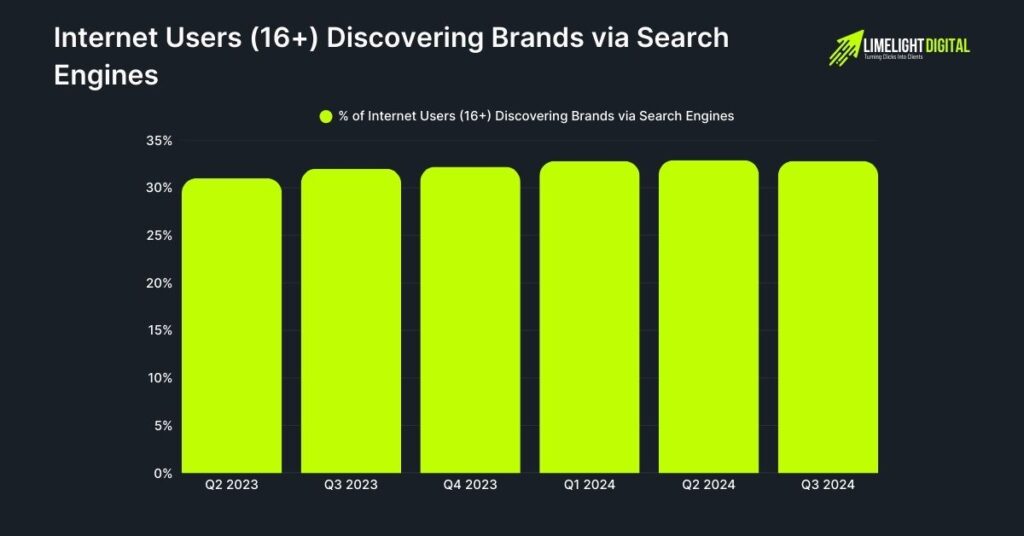
You can see the fluctuations in internet users using search engines for brand discovery over the years:
| Quarter | % of Internet Users (16+) Discovering Brands via Search Engines |
|---|---|
| Q2 2023 | 31% |
| Q3 2023 | 32% |
| Q4 2023 | 32.2% |
| Q1 2024 | 32.8% |
| Q2 2024 | 32.9% |
| Q3 2024 | 32.8% |
| Q4 2024 | 32.9% |
| Q1 2025 | 33.9% |
| Q2 2025 | 32.9% |
Source: DataReportal
The average click-through rate (CTR) on desktop in the UK is 1.13% as of January 2026. This statistic underscores the critical importance of achieving top organic search rankings, as the first position captures a significant share of user clicks.
Source: Advanced Web Ranking
73.7% of marketers plan to maintain or increase investment in voice search optimization in 2026. This indicates a growing recognition among marketers of the increasing prevalence of voice search and its potential impact on future SEO strategies.
Source: HubSpot
More than 20% of internet users worldwide aged 16 and older use voice assistants to find information. This shows the huge adoption of voice technology for getting information.
Source: DataReportal
One of the most commonly used optimization tactics by marketers is Conversion Rate Optimization (CRO), at 50%. This illuminates the aspect of how marketers have been looking to extract every last drop out of their current traffic by making their website or landing page perform better in terms of converting users into customers.
Source: HubSpot
AI SEO vs Traditional SEO
The table below compares Traditional SEO and AI-centric SEO, highlighting the key differences in goals, user behavior, traffic trends, optimization focus, and measurement metrics in today’s evolving search landscape.
| Aspect | Traditional SEO | AI SEO |
|---|---|---|
| Definition | Optimize content to rank in SERPs on Google, Bing, etc. | Optimize content to be understood and cited in AI search engines and summaries. |
| Core Goal | Increase rankings, organic traffic, and clicks. | Gain visibility in AI-generated answers and capture AI search traffic. |
| User Behavior Impact | Users click through to websites from search results. | Many users get answers directly; ~58.5% of Google searches end without a click. |
| Traffic Shift Trends | Still drives most organic traffic today. | AI search traffic growing fast (+527% YoY in 2025 study). |
| Click-Through Rates (CTR) | CTR patterns historically stable. | CTR drops when AI summaries appear (~61% decrease). |
| User Starting Point | Most users start with traditional search engines. | About ~37% of users start with AI tools. |
| Role of Manual Work vs Machine | Heavy manual keyword research and optimization. | AI tools automate analysis and content insights. |
| Skill Focus | Keywords, backlinks, site structure, and on-page SEO. | Natural language, semantic relevance, and AI-readable structure. |
| Measurement Metrics | Rankings, impressions, CTR, backlinks. | AI answer visibility, citation frequency, and intent match. |
| Strategic Implication | Focus on ranking in search results. | Adapt to zero-click behavior and AI visibility metrics. |
Source: Search Engine Land 2, Search Engine Land 3, Semrush, SparkToro
AI Overviews Impact on Organic Clicks
Google AI Overviews are affecting how users interact with traditional search results.
According to an Ahrefs study published in February 2026, the presence of an AI Overview was associated with a 58% lower average click-through rate for the top-ranking page.
The study analyzed 300,000 keywords using Google Search Console data from December 2023 and December 2025.
An earlier Ahrefs study published in April 2025 found a 34.5% reduction in CTR, indicating that the impact of AI Overviews on organic search visibility has increased over time.
Source: Ahrefs
Search Engine Market Research
Google holds 89.82% of the Global Search Engine Market Share as of January 2026. These statistics affirm that Google remains the undeniable winner, with an almost 92% share of the global search engine market, making it an efficient platform for any SEO plan.
Bing holds a 4.45% global market share as of January 2026. While significantly smaller than Google, Bing still maintains a notable market share, making it a relevant platform for some SEO considerations.
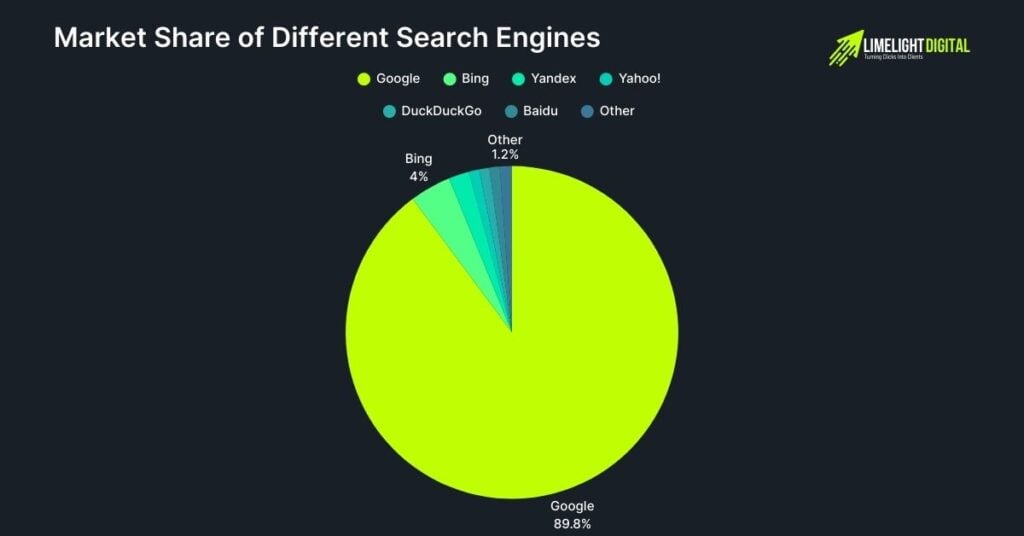
The table below shows the market share of different search engines:
| Search Engine | Market Share (%) |
|---|---|
| 89.82% | |
| Bing | 4% |
| Yandex | 2% |
| Yahoo! | 1% |
| DuckDuckGo | 1% |
| Baidu | 1% |
| Other | 1.18% |
Source: Stat Counter
The global search engine market is projected to expand from $252.5 billion in 2025 to $280.48 billion in 2026 and reach $474.73 billion by 2031, growing at a compound annual growth rate (CAGR) of 11.09% between 2026 and 2031.
| Year | Market Size |
|---|---|
| 2025 | $252.50 billion |
| 2026 | $280.48 billion |
| 2027 | $311.58 billion |
| 2028 | $346.13 billion |
| 2029 | $384.52 billion |
| 2030 | $427.16 billion |
| 2031 | $474.73 billion |
Source: Mordor
The market size of the Search Engines industry in the United Kingdom is £5.4 billion in 2026.
Source: IBIS World
AI-Driven Search Engine
95% of Americans still use traditional search engines (Google, Bing, Yahoo, DuckDuckGo) monthly, even as AI tools grow in adoption.
AI tool adoption among U.S. users jumped from about 8% in 2023 to 38% in 2025, indicating rapid growth in AI search tool use.
This rapid adoption has also fueled innovation across regional tech hubs, even in the UK. AI startups in London are playing a growing role in shaping next-generation search and discovery platforms.
Source: Search Engine Journal 2
58.5% of Google searches now end without a click, as users get answers directly from AI summaries.
Source: Break The Web
Consumer behaviour is shifting way faster than most brands anticipated. Close to 50% of consumers use AI search tools to find products and make buying decisions, showing that discovery is not limited to search engines anymore. This shift is expected to accelerate, with over 75% of Google searches projected to feature AI summaries by 2028.
As AI answers become more comprehensive, click-through behavior is already changing. An estimated 20 to 50% of traditional search traffic is at risk as users get direct responses without visiting websites. In fact, 44% of AI search users now cite AI platforms as their primary source for buying decisions, compared to 31% who rely on traditional search.
Adoption is not limited to one industry. Within electronics, travel, grocery, wellness, apparel, beauty, and financial services categories alone, 40 to 55% of consumers are already using AI-driven search to inform purchases, demonstrating that this behavior exists in both high consideration and everyday categories.
For brands, this creates a visibility challenge. A company’s own website accounts for just 5 to 10% of AI cited sources, while most references come from third-party publishers, affiliates, and user-generated content. Despite this, only 16% of brands currently track performance in AI search, revealing a significant measurement gap as search continues to evolve.
Source: McKinsey
By 2026, ChatGPT reached 910 million weekly active users. This surprise success shows how popular and widely used AI chatbots are, for many purposes, such as retrieving information.
Source: Substack
Google AI Overviews (SGE) reach 2 billion monthly users. The vast user base of Google’s AI Overviews signifies the mainstream integration of AI into traditional search and its potential to reshape user search experiences.
Source: Google
Perplexity AI reached a 6.6% share of the AI search market in October 2025. It signifies a rise of specialized AI search engines penetrating the market to deliver users alternative searching experiences.
Source: SeoProfy
By late 2025, as many as half of all Google searches contain AI summaries. A Google search clouded with AI-generated summaries represents an irreversible turning point in the delivery of information to users and the way content must now be optimized.
Source: McKinsey
By 2028, AI search traffic will likely eclipse traditional search traffic. So here, AI SEO becomes a necessary future bet as an overall trajectory in how we think of search with information shifts more towards being driven by the inputs we usher into non-static search engines.
AI SEO ROI Statistics
A Semrush study found that almost 70% of businesses report higher ROI from using AI in SEO.
In contrast, just 1% think their ROI decreased.
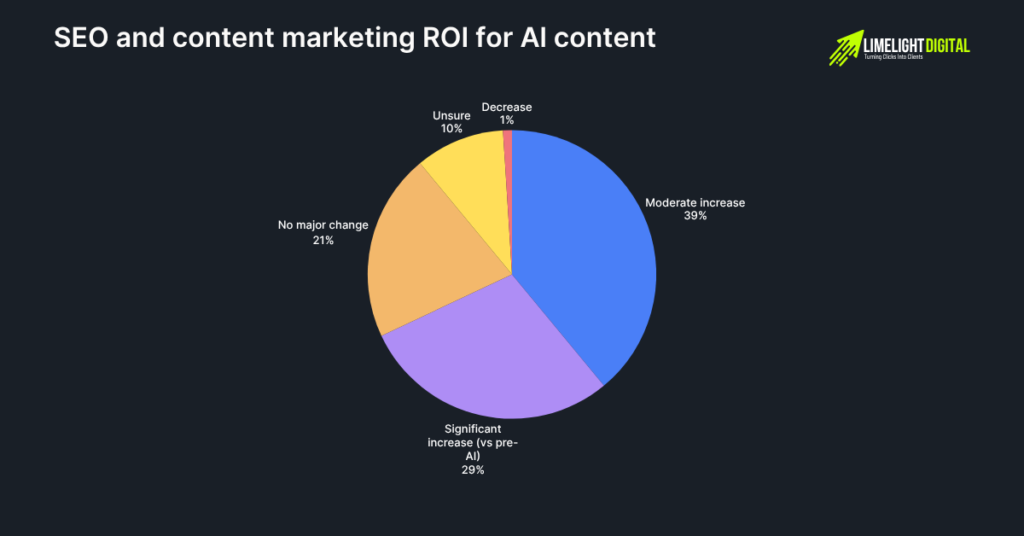
The table below shows different responses to the use of AI for marketing purposes:
| Response | Percentage |
|---|---|
| Moderate ROI increase | 39% |
| Significant ROI increase compared to when AI tools weren’t used | 29% |
| ROI stayed more or less the same | 21% |
| Not Sure | 10% |
| ROI decreased | 1% |
Source: Semrush
98% of marketers plan to increase their AI SEO spend in 2026. This overwhelming commitment from marketers to invest more in AI SEO reflects their confidence in its ability to deliver significant returns and competitive advantages.
As investment rises, many teams are turning to advanced SEO software for agencies to manage AI tracking, automation, and performance reporting at scale.
Source: Typeface
Revenue increases from AI use are most commonly reported in marketing and sales use cases. This highlights the direct impact of AI on business growth, particularly in customer acquisition and revenue generation through optimized marketing and sales efforts.
Source: McKinsey State of AI
75% of companies using AI for marketing plan to shift more budget toward it due to its proven value. This further reinforces the positive ROI companies experience when leveraging AI in marketing, leading to strategic reallocations of resources toward AI-driven initiatives.
Source: Digital Marketing Institute
AI SEO Content Writing
Organizations using AI writing tools report 59% faster content creation. This significant increase in speed demonstrates the efficiency gains offered by AI writing tools, enabling businesses to produce content at a much quicker pace.
To maximise these productivity gains, businesses are increasingly relying on the best SEO tools that combine AI content generation, keyword intelligence, and performance analytics in one platform.
AI writing tools enable a 77% increase in content output volumes. Beyond speed, AI tools also allow for a substantial boost in the sheer quantity of content produced, which can be crucial for maintaining a strong online presence.
Source: Firewire Digital
80% of marketers are already using AI for content creation. Such adoption is a clear indication that AI has now become an inextricable part of most marketers’ content creation process across various content formats.
Now, 75% of marketers are using AI for media production. Such statistics show that AI is not limited to working with text; it can also work with other media, which only goes to show a broader range of its industry usage in advanced eCommerce content marketing.
Source: HubSpot
A study run by originality.ai revealed that the top 20 Google search results contained 17.31% AI-generated content as of September 2025.
July 2025 saw a peak of 19.56% AI content.
AI content saw a sharp rise from 11.46% to 17.96% between September and October 2025.
You can see the growth in AI Content in the table below:
| Month | AI Content % |
|---|---|
| February 2019 | 2.27% |
| April 2019 | 3.77% |
| June 2019 | 3.77% |
| August 2019 | 3.75% |
| October 2019 | 3.25% |
| December 2019 | 3.71% |
| Feb 2020 | 3.22% |
| April 2020 | 2.80% |
| June 2020 | 3.85% |
| August 2020 | 4.13% |
| October 2020 | 4.75% |
| December 2020 | 4.09% |
| Feb 2021 | 4.32% |
| April 2021 | 4.74% |
| June 2021 | 4.90% |
| August 2021 | 4.72% |
| October 2021 | 5.11% |
| December 2021 | 5.74% |
| Feb 2022 | 5.56% |
| April 2022 | 5.65% |
| June 2022 | 5.48% |
| August 2022 | 5.61% |
| October 2022 | 6.04% |
| December 2022 | 5.61% |
| Feb 2023 | 6.79% |
| April 2023 | 6.28% |
| June 2023 | 7.12% |
| August 2023 | 7.41% |
| December 2023 | 8.48% |
| March 2024 | 10.18% |
| April 2024 | 11.34% |
| May 2024 | 11.11% |
| June 2024 | 11.67% |
| July 2024 | 12.59% |
| August 2024 | 11.21% |
| September 2024 | 11.46% |
| October 2024 | 17.96% |
| November 2024 | 18.07% |
| January 2025 | 19.10% |
| May 2025 | 16.57% |
| June 2025 | 16.51% |
| July 2025 | 19.56% |
| August 2025 | 18.74% |
| September 2025 | 17.31% |
Source: Originality
87.8% of businesses said they’re worried about their online findability in the AI era.
85.7% are already investing or plan to invest in AI/LLM optimization.
Source: Search Engine Land 1
AI In Content Marketing Statistics
Content creation is the most common task, with 50% of respondents reporting they use AI to produce slides, blog posts, social media posts, or emails. Close behind, 51% use it to optimise content, such as SEO and email campaigns, showing that refinement is just as important as creation.
In contrast, more strategic or analytical uses are slightly lower: 45% use AI for brainstorming, 41% for analysing data, and 40% for conducting research. Automation sits in the middle at 43%, while only 1% selected “Other,” indicating most usage is concentrated in core content and optimisation activities.
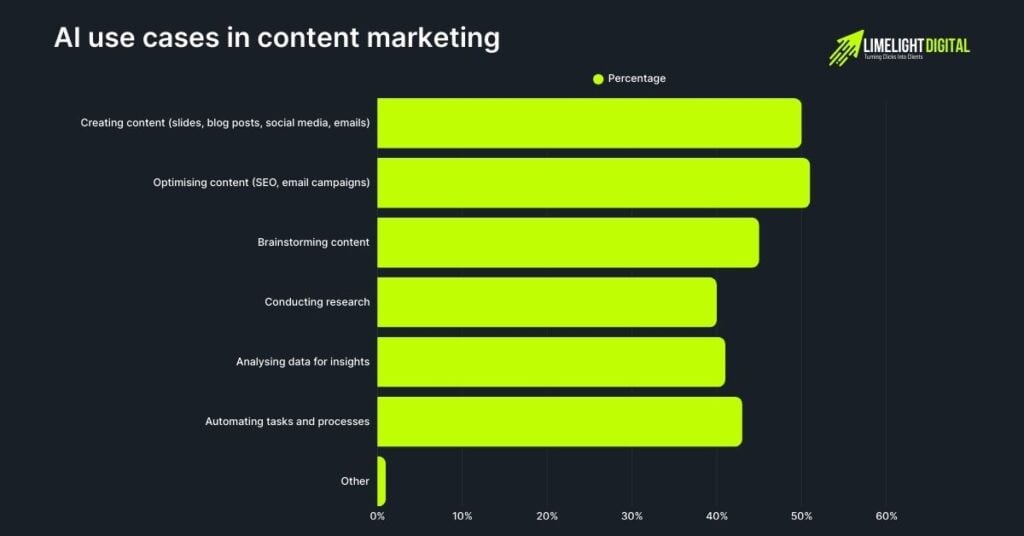
The table below shows common use cases where AI is used:
| Task | Percentage |
|---|---|
| Creating content (slides, blog posts, social media, emails) | 50% |
| Optimising content (SEO, email campaigns) | 51% |
| Brainstorming content | 45% |
| Conducting research | 40% |
| Analysing data for insights | 41% |
| Automating tasks and processes | 43% |
| Other | 1% |
Source: SurveyMonkey
93% of eCommerce brands view AI as a competitive advantage in their marketing strategy. This high percentage reflects the perception among e-commerce businesses that AI is not just a tool but a strategic imperative for gaining a market edge.
Source: Reboot Online
79% of companies report that AI agents are being adopted within their marketing teams. The adoption of AI agents signifies a move towards automating and enhancing various marketing tasks, leading to more efficient and data-driven operations.
Source: Digital Marketing Institute
60% to 80% of marketers use AI at least once a week. This indicates the deep integration of AI into daily workflows for marketers and the frequency with which they described AI as a standard tool.
Source: New Media
By 2028, $750 billion of U.S. revenue is expected to run through AI-powered search. Due to its underlying economics, AI-powered search is expected to generate a significant amount of revenue, and thus it has become a key area for businesses to target for future investment.
Source: McKinsey