Gen Z makes up approximately 2 billion people globally, representing nearly 25% of the world’s total population. They are the most ethnically diverse and digitally immersed generation on record, spending an average of 9 hours per day on screens. Already outnumbering Baby Boomers in the workforce, Gen Z is rapidly reshaping culture, commerce, and careers.
We have compiled a detailed statistical report on Gen Z demographics, behaviour, finances, and mental health.
Key Gen Z Statistics 2026 (Top Picks)
- Gen Z makes up around 2 billion globally
- 77% prioritise work-life balance over other job factors
- 48% of Gen Z report financial insecurity in 2025
- Gen Z spends about 9 hours daily on screens
- 75% value sustainability more than brand name
- 41% of Gen Z prefer social media for search
Gen Z Age Range (Global & UK)
Gen Zs are those individuals born between 1997 and 2012, after millennials (1981-1996) and before Generation Alpha (2013+).
Currently, in 2026, the youngest Gen Zs are 14, whereas the oldest are 29. These range from school teenagers to young professionals.
As of 2023, the UK had around 13.5 million Gen Zs, ranging from age 11 to 26 at that time.
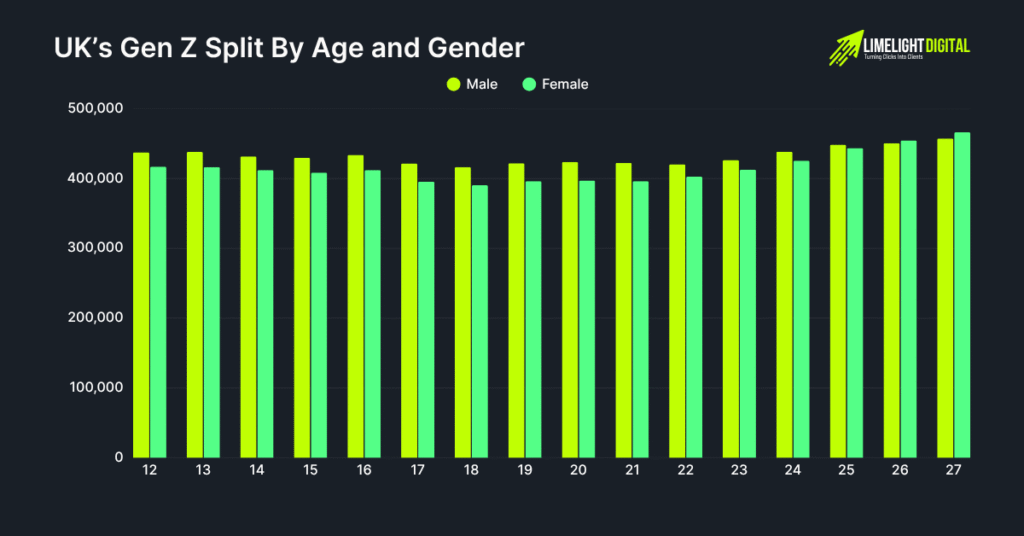
Below you can see the UK’s Gen Z split by age and gender as of 2023:
| Age | Male | Female |
|---|---|---|
| 12 | 437,614 | 417,219 |
| 13 | 438,053 | 416,479 |
| 14 | 431,723 | 412,244 |
| 15 | 429,628 | 408,631 |
| 16 | 433,891 | 412,070 |
| 17 | 421,593 | 395,506 |
| 18 | 416,568 | 390,348 |
| 19 | 422,070 | 396,280 |
| 20 | 423,831 | 397,339 |
| 21 | 422,376 | 396,423 |
| 22 | 420,439 | 402,588 |
| 23 | 426,644 | 412,672 |
| 24 | 438,356 | 425,587 |
| 25 | 448,422 | 443,801 |
| 26 | 450,783 | 454,715 |
| 27 | 457,280 | 466,141 |
Source: Statista
Gen Z is the fourth-largest generation in the UK, behind Millennials, Baby Boomers, and Generation X, but growing quickly in terms of its workforce share as younger members enter working age.
How Many People Are in Gen Z? (Population Data)
Outside the UK, Gen Z is an enormous planetary cohort that constitutes a sizeable proportion of the global population.
And though younger than Millennials, they are so numerous that they have already become the demographic force transforming economics, culture, and technology across the globe.
The global Gen Z population is estimated at around 2 billion people, comprising approximately 25-26% of the total world population, making it the largest generation in history.
Take a look below for a brief overview of all the current existing generations:
| Generation | Birth Years | Age Range (2025) | Population | Share of population |
|---|---|---|---|---|
| Silent Generation | 1928–1945 | 80–97 | 13,741,630 | 4% |
| Baby Boomers | 1946–1964 | 61–79 | 64,448,248 | 19% |
| Generation X | 1965–1980 | 45–60 | 65,432,121 | 19% |
| Millennials | 1981–1996 | 29–44 | 74,104,186 | 22% |
| Generation Z | 1997–2012 | 13–28 | 71,146,116 | 21% |
| Generation Alpha | 2013–2025 | 0–12 | 51,238,687 | 15% |
| Total Population | – | – | 340,110,988 | 100% |
Source: Visual Capitalist
In the United States, Gen Z numbers approximately 71 million people, representing roughly 21% of the US population.
Source: Visual Capitalist
Bloomberg’s 2019 analysis reinforced this scale, with Gen Z accounting for 2.47 billion people and surpassing Millennials at 2.43 billion.
This made Gen Z the largest living generation at that time, based on a 2000-2001 cut-off definition.
Source: Bloomberg
Gen Z Demographics & Diversity
Gen Z is the most ethnically and socially diverse generation on record, a trend that holds both globally and specifically in the UK.
This diversity shapes their values, expectations, and consumption habits in profound ways.
In the UK, as of the 2021 Census, 75% of Gen Z were White, 12% Asian, 6% Black, 5% Mixed, and 3% belonged to another ethnic group.
This makes Gen Z the most ethnically diverse generation aside from Gen Alpha.
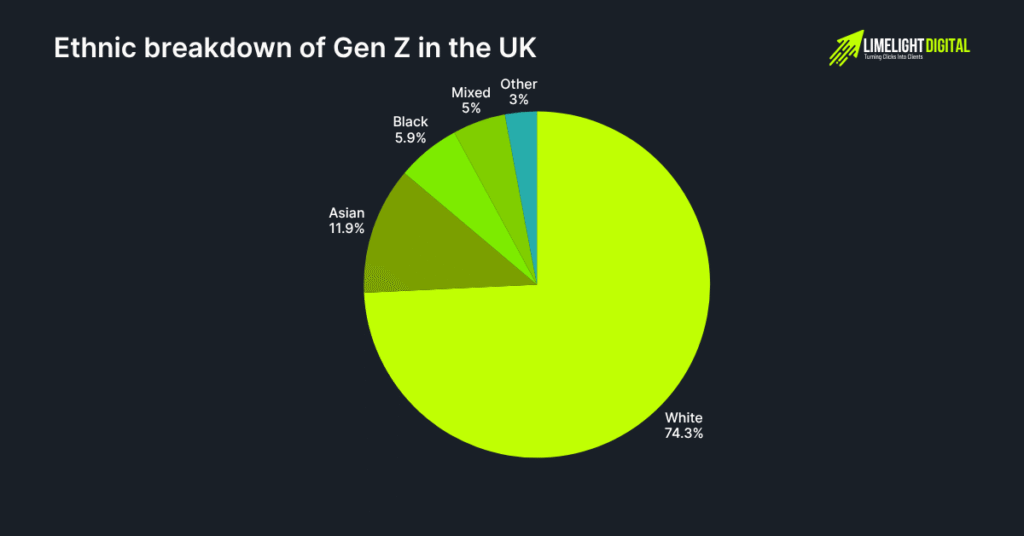
Have a look at the ethnic breakdown of Gen Z in the UK:
| Ethnic Group | Percentage (%) |
|---|---|
| White | 75% |
| Asian | 12% |
| Black | 6% |
| Mixed | 5% |
| Other | 3% |
Source: Statista
By comparison, 78% of UK Millennials identify as White, versus 91% of Baby Boomers, illustrating how each successive generation has become more ethnically diverse.
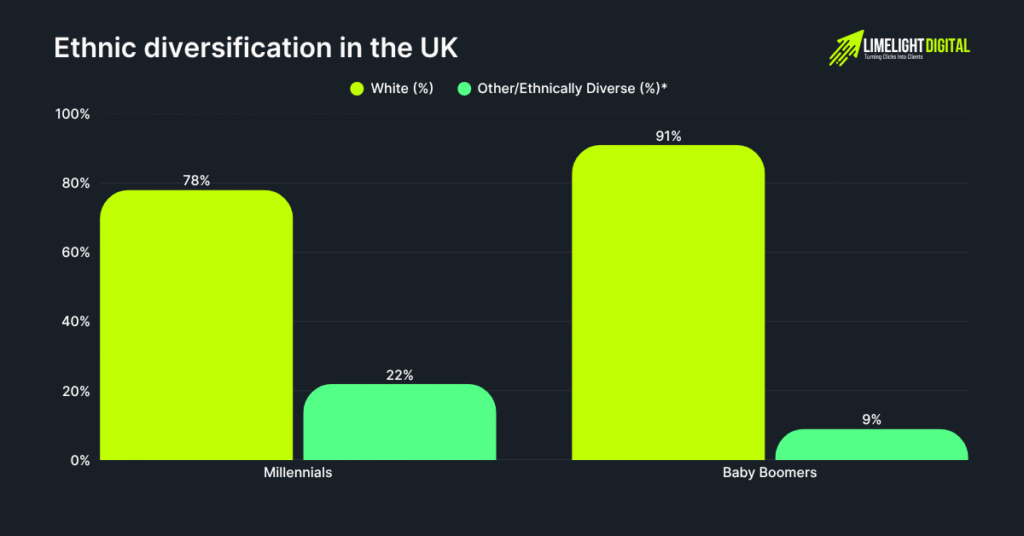
Below is the split of white vs other ethnicity UK population split by generation:
| Generation | White (%) | Other/Ethnically Diverse (%)* |
|---|---|---|
| Millennials | 78% | 22% |
| Baby Boomers | 91% | 9% |
Source: Statista
Academically, Gen Z also outpaces previous generations: in 2017, 59% of 18- to 20-year-old high school graduates were enrolled in college, compared with 53% of Millennials and 44% of Gen Xers at the same age.
Source: Pew Research Center
In the US, meanwhile, 22% of Gen Zers have at least one immigrant parent, compared to just 14% of Millennials, reflecting the growing globalisation of Western societies.
Source: Pew Research Center
Gen Z Workforce Statistics
Gen Z is now firmly embedded in the global workforce, bringing with it a distinct set of expectations around flexibility, purpose, and workplace culture.
Q3 2023 marked the first time Gen Z workers surpassed Baby Boomers in the U.S. labour force. By Q2 2024, Gen Z comprised 18% of the labour force compared to Boomers’ 15%.
Source: Trendlines
Looking further ahead, Gen Z and Millennials are projected to make up 74% of the global workforce by 2030.
Source: Deloitte
In the UK, 4.3 million Gen Z workers were employed in 2022, making Gen Z the third-largest employed generation behind Millennials (12.2 million) and Gen X (11.4 million).
Yet by 2025, nearly one million young people aged 16-24 were not in education, employment, or training (NEET), highlighting growing challenges for this cohort.
Source: Statista, CNBC
Further illustrating this pressure, 1.2 million graduate applications were submitted for just 17,000 open graduate roles in 2023/2024, the most competitive graduate job market on record since 1991.
Source: ISE
Despite these barriers, Gen Z’s workplace expectations remain clear: 77% prioritise work-life balance above almost everything else when evaluating job opportunities, more than any previous generation.
Source: ET HRWorld
Values also matter deeply: 44% of Gen Zers are willing to turn down an employer whose values do not align with their own ethical or sustainability beliefs.
Source: Deloitte
Flexibility is equally non-negotiable, 72% of Gen Z is the most likely generation to have left or considered leaving a job due to a lack of flexible working policy.
Source: LinkedIn
Perhaps most strikingly, just 6% of Gen Z say reaching a leadership position is their primary career goal, even though 76% are interested in a senior leadership role at some point. The most common barriers they cite are stress and burnout (50%) and concerns about work-life balance (41%).
AI is now embedded in how this generation works: 74% of Gen Z report using AI in their day-to-day work in 2026, up sharply from 57% the year before.
Source: Deloitte
Gen Z Financial & Economic Outlook
Despite stereotypes of reckless spending, Gen Z is grappling with genuine structural financial barriers, from a frozen housing market to stagnant wages.
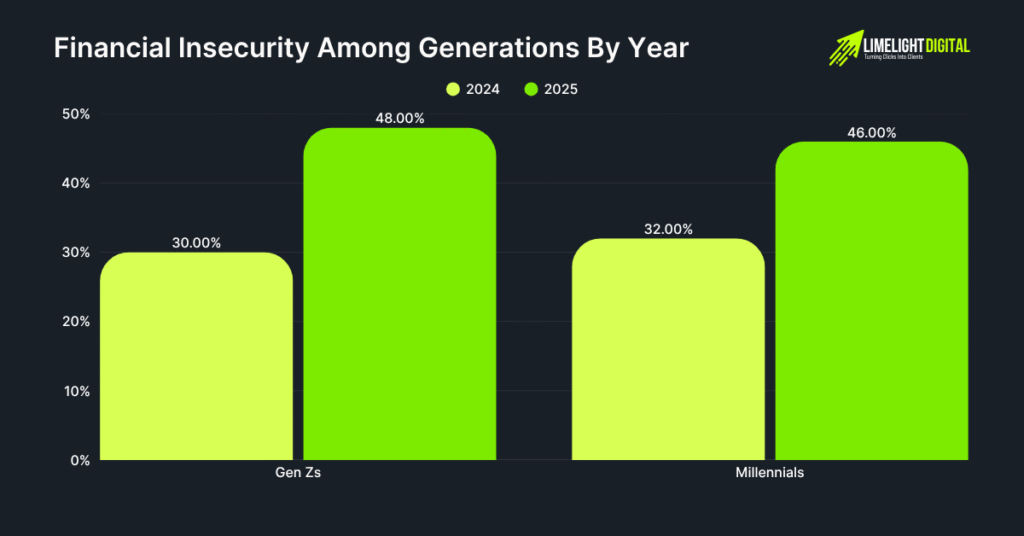
Their financial insecurity is not a myth: Gen Z financial insecurity surged from 30% in 2024 to 48% in 2025, a 60% increase in just one year.
| Group | Year | % Not Financially Secure |
|---|---|---|
| Group | Year | % Not Financially Secure |
| Gen Zs | 2025 | 48% |
| Gen Zs | 2024 | 30% |
| Millennials | 2025 | 46% |
| Millennials | 2024 | 32% |
Financial strain remains widespread: 55% of Gen Z say they have delayed major life decisions such as marriage, starting a family, or launching a business because of their financial situation, and 69% say housing affordability directly affects their career choices and where they can work. Despite this, 53% remain optimistic their finances will improve within the next year.
In the UK specifically, around 41% of Gen Z say they live payslip to payslip, and 46% have delayed major life decisions due to their finances.
Source: Deloitte
This strain is acutely felt in the UK, where 48% of Gen Zers report being financially insecure, with one-third relying on parents for housing costs and bills.
Home ownership among UK 25-year-olds has approximately halved over the past 20 years, falling from around 46% to 20%. Among the broader 25–34 age group, ownership fell from 59% to 41% between 2003/04 and 2019/20.
Source: Commons Library, IFS
Reflecting a similar pessimism, 62% of Gen Z in the US do not expect to ever own a home, given the widening gap between housing costs and entry-level wages.
Source: Scotsman Guide
Nevertheless, financial ambition persists: 59% of Gen Zers say they want to save more money.
There has also been a 46% increase in 18-27-year-olds in the US and UK holding stocks and shares since 2017.
Source: GWI
Gen Z Social Media Behaviour
Gen Z grew up before smartphones and social media were optional add-ons, but core infrastructure. Their online comportment is a more fragmented, intense, and purposeful thing than any generation that has come before them.
But alongside this intensity of engagement, signs of digital fatigue are also emerging.
Gen Z spends an average of 9 hours per day on screens, with much of this time driven by short-form video consumption on platforms such as Instagram Reels, which continue to dominate engagement trends.
Over an 80-year average lifespan, this adds up to an estimated 28.8 years of total screen time.
Source: The Jolt App
This digital immersion has reshaped how they seek information: 41% of Gen Z now turn to social media first when searching, placing it ahead of traditional search engines (32%) for the first time.
| Metric / Behaviour | Gen Z | All Consumers / Age Groups |
|---|---|---|
| Turn to social platforms first when looking for information | 41% | – |
| Turn to traditional search engines first | 32% | – |
| Turn to chat-based AI tools first | 11% | – |
| Turn to friends/family first | 9% | – |
| Prefer social first for product reviews/recommendations | – | 37% |
| Prefer social first for local restaurants/activities | – | 35% |
| Influenced by social content in the past 6 months | 90% | 76% |
| Millennials influenced by social content | – | 84% |
Source: Sprout Social
In the UK specifically, TikTok is now the single most-used news access point for 12-15-year-olds, with a 30% adoption rate for news consumption, according to Ofcom’s 2025 report.
Source: Ofcom
Platform use is also notably broad: females aged 16 to 24 average 7.65 social media platforms each month, while males average slightly more at 7.67.
Source: Datareportal
This intensity, however, comes at a cost: 73% of Gen Z globally report feeling digitally exhausted, and 63% planned a social media detox in 2024.
Source: Metricool
As of 2026, the UK has 55.5 million social media user identities (79.7% of the population), with TikTok users aged 18 and above numbering approximately 26.8 million.
Source: Datareportal
Despite this, 78% of Gen Z admit feeling addicted to their phone or social media, yet many also report having mostly good mental health days, a complex but important distinction.
Source: Harmony
Gen Z Consumer Behaviour & Brand Preferences
Gen Z’s purchasing power is growing fast, but their brand relationships are defined by values, ethics, and authenticity, not just price or convenience.
They are, by most measures, the most commercially disruptive consumer generation in history.
Sustainability sits at the heart of this: 75% of Gen Z say it is more important than brand name when purchasing, and approximately 64% are willing to pay more for sustainable products.
Ethics are equally decisive: 64% would stop buying from a company linked to unethical suppliers, and 64% would boycott a brand exposed for unethical practices.
Source: Opentext
This values-driven mindset shapes shopping habits too: 61% of Gen Z shoppers look for used or secondhand items before buying new.
As a result, the global resale market is projected to exceed $1 trillion by 2032.
Source: Cropink, MMR
When it comes to product discovery, 49% of Gen Z use TikTok, while 21% each use Instagram and Facebook.
Source: Sprout Social
Beyond individual purchases, 79% of Gen Z believe businesses should do more to help consumers shop sustainably, and 30% actively research a company’s environmental policies before accepting a job offer.
| Action | Gen Zs – already do/have done | Gen Zs – plan to in the future | Millennials – already do/have done | Millennials – plan to in the future |
|---|---|---|---|---|
| Research companies’ environmental impact/policies before accepting a job from them | 27% | 32% | 25% | 30% |
| Change job due to environmental impact concerns | 20% | 26% | 19% | 23% |
Additionally, 54% of surveyed Gen Z, along with their colleagues, are pressurising their employers to take action on climate change, compared to 48% of millennials.
Source: Deloitte
In the UK, just over a third of consumers chose brands demonstrating environmentally sustainable practices, while 28% have stopped buying from brands with poor ethical or sustainability values.
Source: World Economic Forum
Gen Z and Millennials are also five times more likely than older generations to believe newer brands are more innovative than established ones, a structural shift in brand loyalty.
Source: McKinsey
Gen Z Mental Health & Wellbeing Statistics
Mental health is the defining well-being challenge of the Gen Z era.
Shaped by a global pandemic, economic precarity, and constant digital comparison, Gen Z faces a mental health landscape more clinically prevalent than any previous generation.
Nearly half (46%) have already received a formal mental health diagnosis, and a further 37% believe they have an undiagnosed condition.
Anxiety is the most common diagnosis, followed by depression and ADHD.
Source: Harmony
Despite this, stress remains widespread: 71% of Gen Z and 63% of Millennials report having needed to take time off work due to stress.
Source: Deloitte
In the UK, the impact is measurable: a mental health crisis is keeping approximately 3 million Gen Zers out of work.
Gen Z workers are also taking more sick leave than Gen Xers, who are 20 years their senior.
Source: Fortune
Despite this, workplace openness remains limited: only 56% of Gen Z feel comfortable discussing mental health challenges with their managers.
Source: SHRM
Yet the appetite for change is clear, 92% of recent graduates wish to discuss mental wellness at work openly, though reality consistently falls short of this expectation.
Source: Monster
Worryingly, employer investment in UK mental health support is projected to fall from 65% in 2025 to just 45% by 2026, putting younger workers at particular risk.
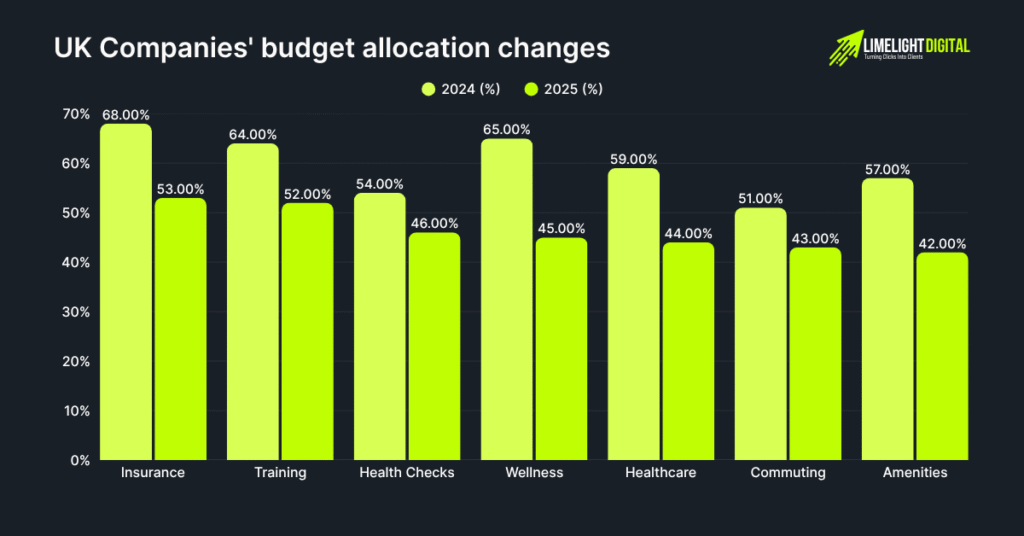
Below are the UK companies’ budget allocation changes
| Subcategory | 2024 (%) | 2025 (%) |
|---|---|---|
| Various types of insurance | 68% | 53% |
| Training and development opportunities | 64% | 52% |
| Health assessment benefit | 54% | 46% |
| Mental wellness programs | 65% | 45% |
| Comprehensive occupational healthcare | 59% | 44% |
| Commuting allowances | 51% | 43% |
| On-site amenities | 57% | 42% |
Source: GEBS 2025
Gen Z vs Millennials (Quick Comparison)
Take a look at the table below for a quick skim of Gen Z and Millennial comparison across different categories:
| Category | Gen Z (1997-2012) | Millennials (1981-1996) |
|---|---|---|
| Age in 2026 | 14-29 | 30-45 |
| Global Population Share | ~23% (≈1.9B) | ~21% (≈1.7B) |
| Workforce Presence | Rapidly growing (18%+) | Dominant but plateauing |
| Career Priorities | Work-life balance (77%), purpose-driven | Career growth, stability |
| Leadership Ambition | Low (only 6% prioritise it) | Higher leadership aspirations |
| Job Switching Behaviour | High if values/flexibility mismatch | Moderate, more stability-focused |
| Financial Security (2025) | 48% insecure | 46% insecure |
| Living Situation | More likely to rely on parents | More financially independent |
| Home Ownership Outlook | Pessimistic (many don’t expect to own homes) | Slightly more optimistic |
| Saving & Investing | Increasing interest (stocks +46%) | More established investors |
| Education Participation | Higher college enrollment rates | Lower at the same age historically |
| Diversity | Most diverse generation | Less diverse than Gen Z |
| Social Media Usage | Very high (≈9 hrs/day screen time) | High but less intense |
| Search Behaviour | Social-first (41%) | More search engine-first |
| Platform Use | Multi-platform (7+ apps/month) | Fewer platforms on average |
| Digital Wellbeing | High digital fatigue (73%) | Lower digital fatigue |
| Consumer Values | Sustainability-first, ethics-driven | Value + convenience balance |
| Brand Loyalty | Low prefers new brands | Higher loyalty to established brands |
| Secondhand Shopping | Common (61%) | Less common |
| Mental Health Awareness | Very high (46% diagnosed) | Lower diagnosis/reporting rates |
| Work Expectations | Flexibility, well-being, purpose | Stability, salary, progression |