
The total number of headline offences in the UK in 2025 was 9.6 million, with fraud being the most prevalent crime, with 4.4 million instances, which is 30% higher than in 2017. Although violent crimes worry many people, murders fell to the lowest levels in 10 years, and there was a 10% drop in knife crime. The crime rate in the UK is 72 per 1,000 people.
The following statistics report on crime rates, demographics, and types of offences in the UK have been gathered from reliable third-party sources.
Key UK Crime Statistics 2026
- The CSEW recorded 9.6 million headline crime incidents in 2025.
- Fraud is now the most common crime in the UK, accounting for 4.4 million incidents in 2025.
- The UK crime rate stands at 72 crimes per 1,000 people as of April 2026.
- Violence is down 75% from its 1995 peak, and homicides fell to just 503 cases in 2025.
- Knife crime fell 10% to 49,151 offences in 2025, and knife-related homicides dropped 21% to 172.
- Male arrests outnumber female arrests by a ratio of 5.42 to 1 in England and Wales.
UK Crime Rate Overview
Statistics from the CSEW show that a total of approximately 9.6 million core criminal incidents were recorded between April 2024 and March 2025, covering various categories of crime.
Source: ONS 1
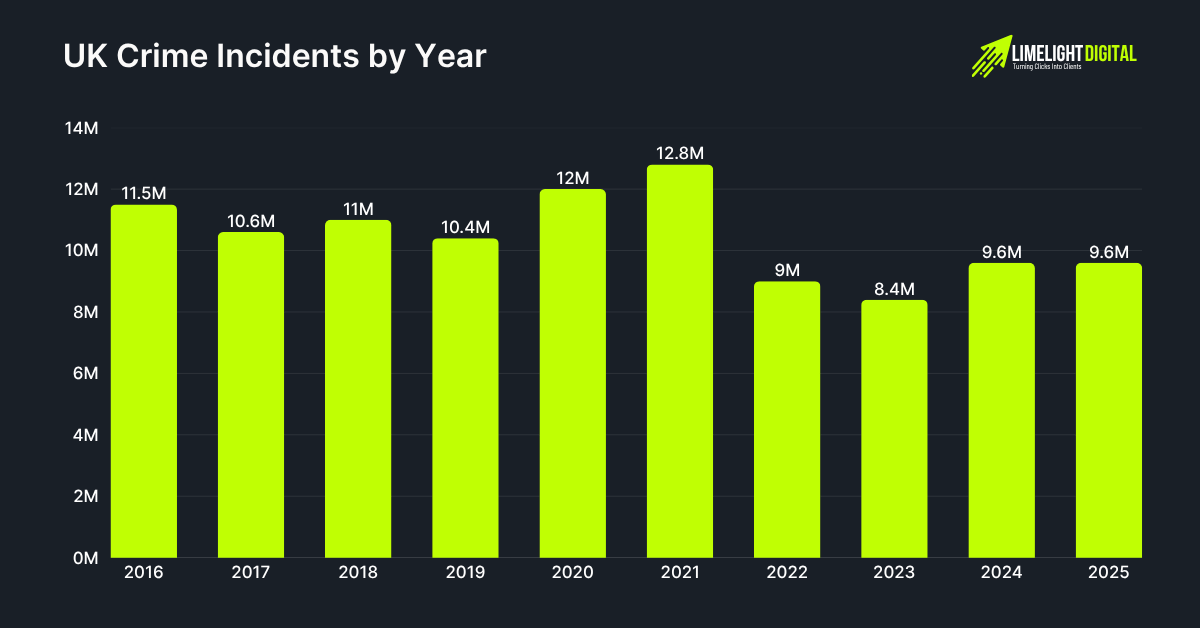
The following table contains some statistics regarding the total number of reported crimes within the whole of the UK from the years 2016 to 2025.
| Year | Incidents Of Crime |
|---|---|
| 2025 | 9.6 million |
| 2024 | 9.6 million |
| 2023 | 8.4 million |
| 2022 | 9 million |
| 2021 | 12.8 million |
| 2020 | 12 million |
| 2019 | 10.4 million |
| 2018 | 11 million |
| 2017 | 10.6 million |
| 2016 | 11.5 million |
Source: ONS
Crime in England
In the year ending March 2025, the CSEW estimated 9.4 million headline crime incidents across England and Wales. That 7% increase was driven almost entirely by a 31% surge in fraud.
Violence with or without injury remained stable at around 1.1 million CSEW incidents. That represents a 36% decrease compared with a decade ago and a 75% reduction from the 1995 peak.
Source: ONS 1
Robberies were reduced gradually over the years as well. The Crime Survey for England and Wales revealed that 2.6 million robberies were committed in the year ending December 2025, a number 77% less than the highest number ever seen in 1995.
Source: ONS
The UK crime rate stood at 72 crimes per 1,000 people as of April 2026 (excluding Scotland). England had the highest rate at 68 per 1,000 people.
| Country | Crime Rate per 1,000 people | Year-on-Year Difference |
|---|---|---|
| United Kingdom (excl. Scotland) | 72 | -2.77% |
| England | 68 | -1.68% |
| Wales | 62 | -18.27% |
| Northern Ireland | 36 | -4.72% |
Source: CrimeRate
UK Crime Statistics by Year
There have been changes in the nature of crimes committed in England and Wales during the last few years compared to the declining crime trend that started in the mid-1990s.
Between 2022 and 2025, overall crime levels remained below pre-pandemic and historical highs, while fraud, theft from the person, and shoplifting emerged as notable areas of concern.
- 2022: The Crime Survey for England and Wales (CSEW) estimated 9 million offences, a 12% decrease compared with the pre-pandemic year ending March 2020. Overall theft fell by 20%, while criminal damage declined by 24%.
- 2023: Headline crime stayed roughly the same, at 8.4 million, despite being lower for many years now and 25% lower than in 2017. The decrease was 16 percent for fraud, but 29% higher for computer misuse.
- 2024: Crime increased to 9.6 million incidents, up 14% from 2023, driven largely by a 33% rise in fraud (4.1 million incidents) and a 13% increase in theft. Theft from persons rose by 50%, reflecting growing concerns around street crime.
- 2025: Total headline crime did not change much from year to year and stood at an average level of 9.6 million. Thefts have reduced by 11%, while the level of fraud continued to be high (4.4 million), rising by about 30% compared to 2017.
- As for higher-harm criminal offenses, the number of homicides has been decreasing consistently from 632 to 503.
- While the prevalence of knife offences remained high and erratic, rising to 54,587 in 2024 before declining by 10 percent to 49,151 in 2025, there were fewer cases of firearm-related offences than ever before.
- There was an emergence of theft, rising from 430,104 cases in 2023 to a record 516,971 cases in 2024, then moderating slightly.
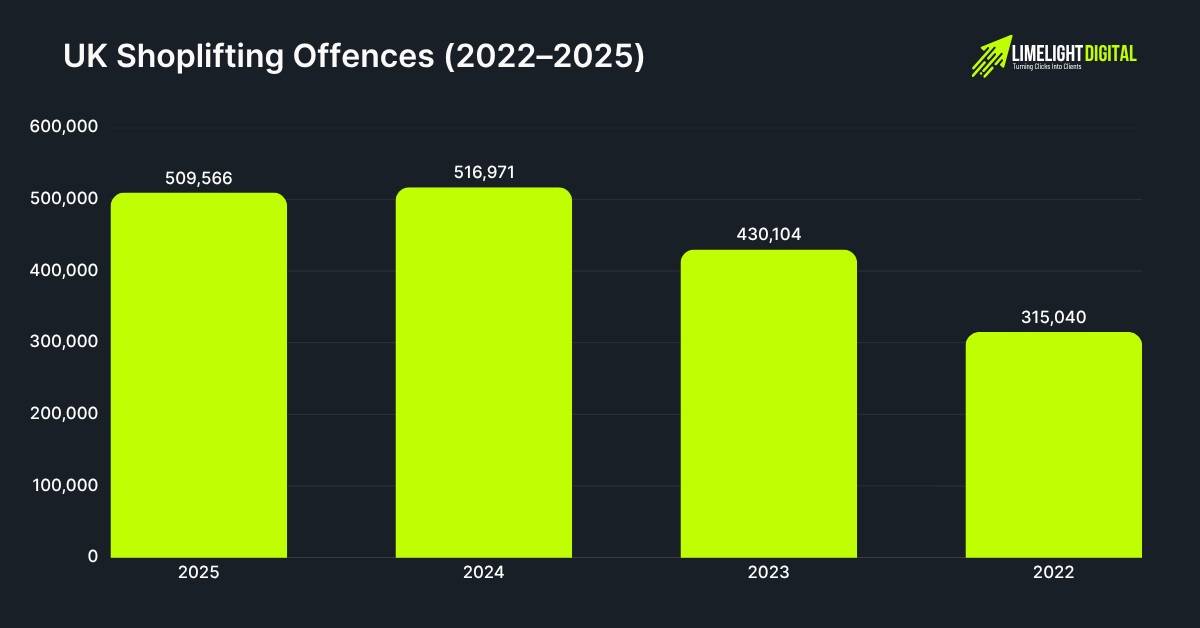
The chart below shows the rapid rise of shoplifting cases over:
| Year | Shoplifting Offences |
|---|---|
| 2025 | 509,566 |
| 2024 | 516,971 |
| 2023 | 430,104 |
| 2022 | 315,040 |
Source: ONS
UK Crime Statistics by City
The following sections compare crime levels across major UK cities, beginning with London before examining Manchester and other high-crime urban areas.
London Crime Rate
London recorded 957,481 offences in the 12 months to December 2024, equating to roughly 107 crimes per 1,000 residents. That places London mid-table among UK police force areas.
London’s rate is actually lower than Greater Manchester’s (109.9 per 1,000), West Yorkshire’s (115 per 1,000), and Cleveland’s (124.6 per 1,000). Despite its reputation, the capital is not the highest crime area per capita.
Source: eufy
Westminster recorded the highest crime rate of any London borough at 195.78 per 1,000 residents in 2024. Camden followed at 172.4 per 1,000. Both areas are heavily affected by tourism and nightlife foot traffic.
Source: Alpha Security
The safest London boroughs include Richmond upon Thames, with around 54-61 crimes per 1,000 residents, and Sutton, with approximately 61 per 1,000.
Shoplifting drove much of the recent increase, with 45,224 offences in the first six months of 2025 alone. Knife crime, by contrast, fell 7% in the 12 months to August 2025.
Source: eufy
Crime Statistics Manchester
Greater Manchester Police reported an 8% drop in recorded crime in the 12 months to December 2024. That amounted to nearly 30,000 fewer incidents across the force area.
Neighbourhood crime reductions were notable. Theft from the person fell 28.2%, vehicle offences dropped 18.5%, and residential burglary decreased 11.3%.
GMP also made over 70,000 arrests in 2025, a 4.35% increase on the previous year. Crimes solved rose by 12.6%. These improvements followed operational reforms introduced since 2021.
Source: GMP
The overall crime rate for Greater Manchester sits at approximately 108.2 per 1,000 population in 2024/25. Manchester city itself records higher figures due to its concentrated nightlife districts.
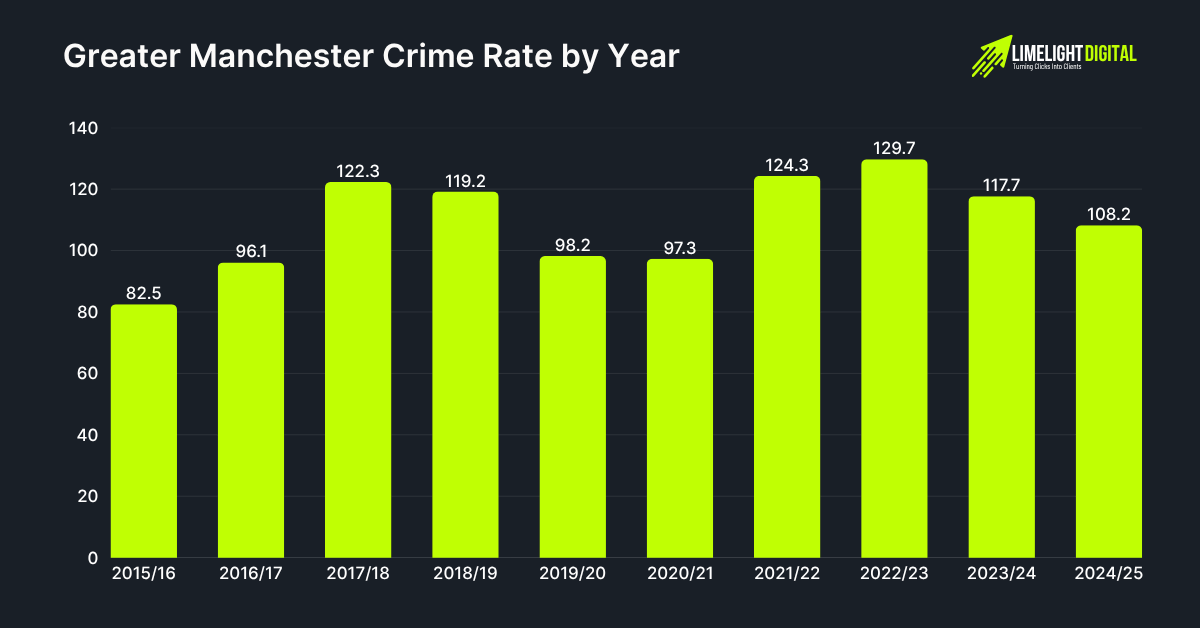
The following table displays Greater Manchester’s crime rate per 1,000 population over the last decade:
| Year | Greater Manchester Police (Manchester)* |
|---|---|
| 2015/16 | 82.5 |
| 2016/17 | 96.1 |
| 2017/18 | 122.3 |
| 2018/19 | 119.2 |
| 2019/20 | 98.2 |
| 2020/21 | 97.3 |
| 2021/22 | 124.3 |
| 2022/23 | 129.7 |
| 2023/24 | 117.7 |
| 2024/25 | 108.2 |
Source: Statista
Most Dangerous City in the UK
Bradford holds the highest crime index score in the UK at 68.1, followed by Coventry (64.9) and Birmingham (63.5)..
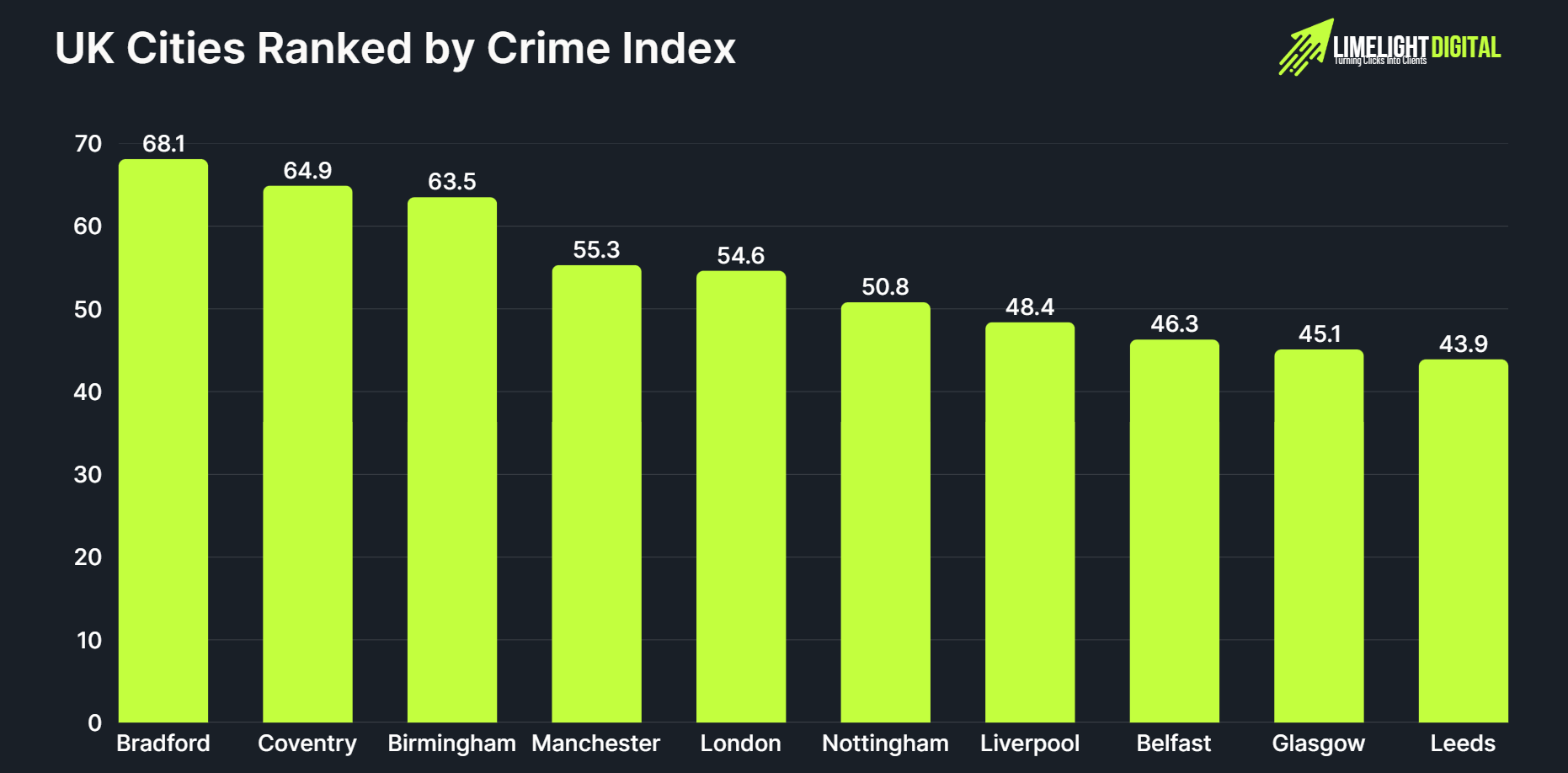
Here is a table ranking UK cities by their overall crime index score:
| Rank | Cities | Crime Index |
|---|---|---|
| 1 | Bradford | 68.1 |
| 2 | Coventry | 64.9 |
| 3 | Birmingham | 63.5 |
| 4 | Manchester | 55.3 |
| 5 | London | 54.6 |
| 6 | Nottingham | 50.8 |
| 7 | Liverpool | 48.4 |
| 8 | Belfast | 46.3 |
| 9 | Glasgow | 45.1 |
| 10 | Leeds | 43.9 |
Source: unhomes
West Yorkshire recorded the highest crime rate among large city forces in 2024/25.
The following table compares crime rates per 1,000 people across major UK police force areas:
| Year | 2024/25 |
|---|---|
| Metropolitan & City of London Police (London) | 105.5 |
| West Midlands Police (Birmingham) | 103.7 |
| Greater Manchester Police (Manchester)* | 108.2 |
| West Yorkshire Police (Leeds/Bradford) | 114.5 |
| Merseyside Police (Liverpool) | 92.7 |
| Northumbria Police (Newcastle/Sunderland) | 93.5 |
| South Yorkshire Police (Sheffield) | 106.3 |
Source: Statista
UK Crime Demographics
Crime does not affect all groups equally. Age, gender, and ethnicity all influence both victimisation risk and interaction with the criminal justice system.
UK Crime Statistics by Gender
In 2024/25, over 630,000 men and 120,000 women were arrested in England and Wales.
On average, male arrests in England and Wales were 5.42 times more than female arrests throughout the observed period.
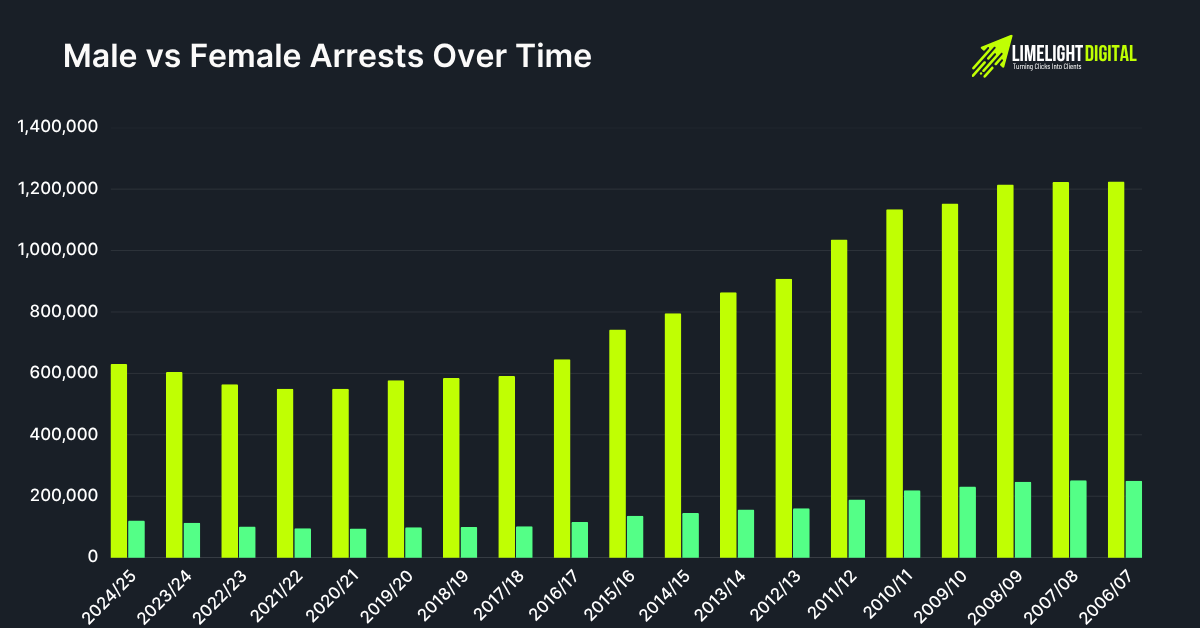
The table below shares the annual breakdown of arrests by gender from 2006 to 2025:
| Year | Male | Female |
|---|---|---|
| 2024/25 | 630,385 | 120,578 |
| 2023/24 | 604,374 | 113,853 |
| 2022/23 | 564,539 | 101,157 |
| 2021/22 | 550,079 | 95,670 |
| 2020/21 | 549,698 | 94,825 |
| 2019/20 | 577,692 | 98,784 |
| 2018/19 | 585,139 | 100,037 |
| 2017/18 | 591,181 | 102,500 |
| 2016/17 | 645,944 | 116,475 |
| 2015/16 | 743,311 | 136,259 |
| 2014/15 | 796,032 | 145,660 |
| 2013/14 | 864,255 | 157,101 |
| 2012/13 | 908,083 | 160,740 |
| 2011/12 | 1,035,981 | 189,142 |
| 2010/11 | 1,134,628 | 219,112 |
| 2009/10 | 1,153,473 | 231,849 |
| 2008/09 | 1,215,012 | 247,127 |
| 2007/08 | 1,223,357 | 251,909 |
| 2006/07 | 1,224,482 | 250,361 |
Source: Statista 2
UK Crime Statistics by Age
Young adults face the highest victimisation risk. 16 to 24-year-olds are twice as likely to be victims of violent crime as any other age group. That reflects greater exposure to nightlife, public spaces, and peer group violence.
Source: UK Victim Report
A third of Black homicide victims were aged 20 or younger, compared with 14% of White victims.
Source: UK Gov
In the youth justice system, juveniles aged 10 to 17 accounted for 18% of knife offence cases. The prison population is ageing, with 18% of prisoners now over 50 compared to 9% in 2010.
Source: House of Commons 1, House of Commons 2
UK Crime Statistics by Race
Black people had an arrest rate of 20.4 per 1,000 population in the year ending March 2023, compared with 9.4 per 1,000 for White people. That means Black individuals were over twice as likely to be arrested.
Here is a table displaying arrest rates per 1,000 population broken down by ethnic group:
| Ethnicity | Rate per 1,000 | Number of arrests |
|---|---|---|
| Asian | 8.4 | 46,396 |
| Bangladeshi | 9 | 5,581 |
| Chinese | 2.8 | 1,240 |
| Indian | 5 | 8,435 |
| Pakistani | 11.3 | 17,984 |
| Asian other | 13.5 | 13,156 |
| Black | 20.4 | 49,243 |
| Black African | 13.1 | 19,465 |
| Black Caribbean | 22.7 | 14,164 |
| Black other | 52.4 | 15,614 |
| Mixed | 12.5 | 21,555 |
| Mixed White and Asian | 5 | 2,421 |
| Mixed White and Black African | 10.4 | 2,597 |
| Mixed White and Black Caribbean | 18 | 9,213 |
| Mixed other | 15.7 | 7,324 |
| White | 9.4 | 456,393 |
| White British | 9.2 | 405,964 |
| Gypsy or Irish Traveller | 17.2 | 1,165 |
| White Irish | 10.7 | 5,441 |
| Roma | 0.1 | 8 |
| White other | 11.9 | 43,815 |
| Other | 8.5 | 10,656 |
| Arab | 4.8 | 1,605 |
| Any Other Ethnic Background | 9.8 | 9,051 |
Source: UK Gov 2
Stop and search disparities are starker still. Black people were stopped and searched at a rate 3.7 times higher than White people in 2023/24.
Source: The World Data
In victimisation data, the estimated rate of personal crime victimisation increased to 12.1% for Black individuals in 2024/25, up from 9.2% the previous year. The increase was driven mainly by rises in fraud.
Source: UK Gov 3
UK Crime Statistics by Ethnicity
In 2024/25, White individuals accounted for 79% of arrests, with 8% Asian, 7% Black, 4% Mixed ethnicity, and 2% Other. These proportions have remained stable over recent years.
Source: Ethnicity and the Criminal Justice System
Ethnic minority individuals comprised 27% of the prison population in 2024, despite representing roughly 18% of the general population. Black prisoners made up approximately 12% of inmates while accounting for around 4% of the population.
Source: House of Commons
People of mixed ethnicity are at least 44% more likely to be a victim than any other ethnic group.
Source: Get Licensed
UK Crime Statistics By Type
Different categories of crime are following very different trajectories. Fraud is rising, violence is stable, and weapon-related offences are declining.
What Is the Most Common Crime in the UK?
Fraud is now the most common crime in the UK by volume. The CSEW estimated approximately 4.4 million fraud incidents in the year ending December 2025.
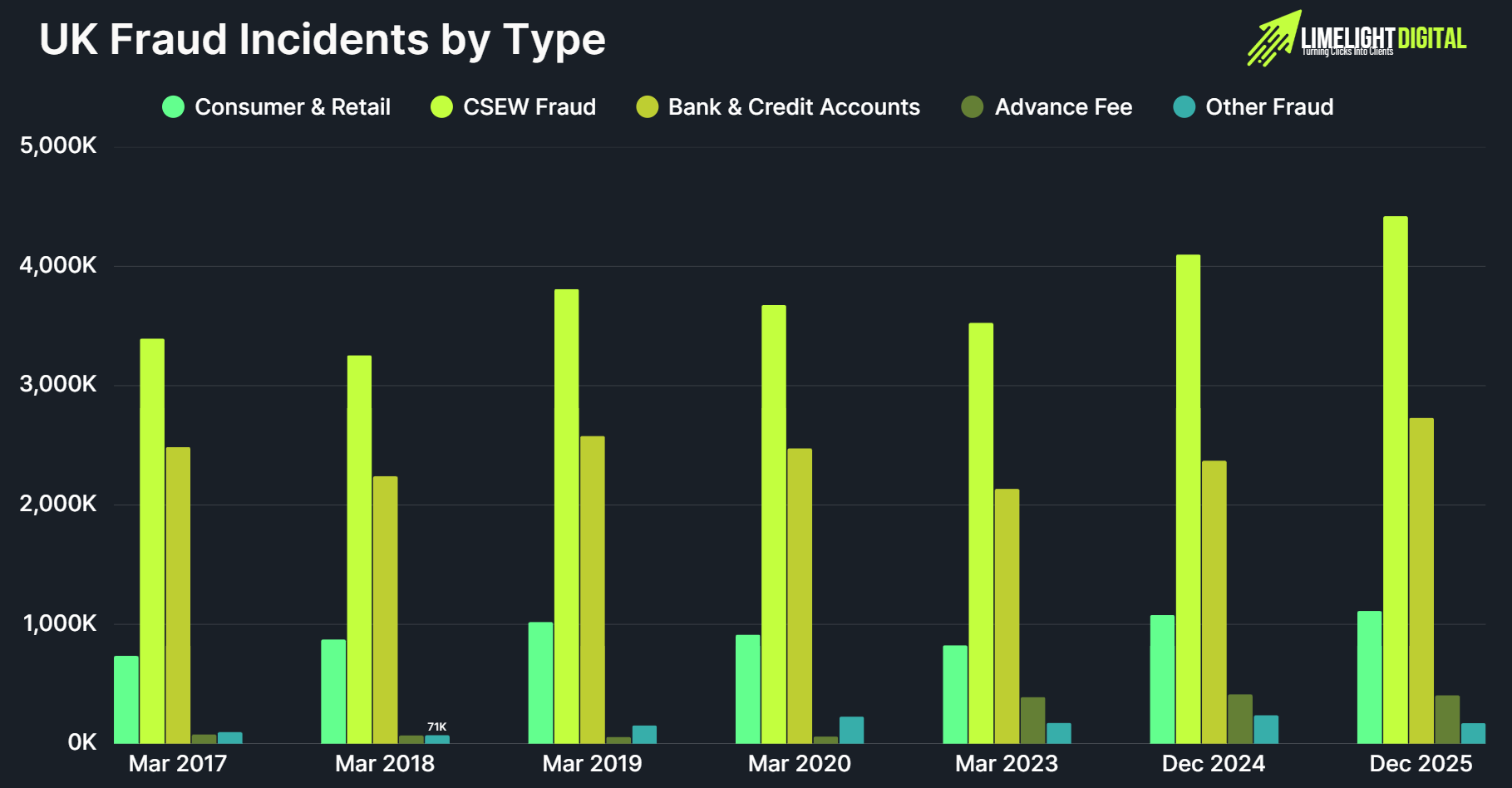
The following table displays fraud incidents recorded by the CSEW, broken down by fraud category:
| Year & Month | CSEW Fraud | Bank & Credit Accounts | Consumer & Retail | Advance Fee | Other Fraud |
|---|---|---|---|---|---|
| March 2017 | 3,395,000 | 2,485,000 | 736,000 | 77,000 | 97,000 |
| March 2018 | 3,255,000 | 2,241,000 | 873,000 | 69,000 | 71,000 |
| March 2019 | 3,809,000 | 2,579,000 | 1,019,000 | 57,000 | 154,000 |
| March 2020 | 3,676,000 | 2,474,000 | 914,000 | 60,000 | 227,000 |
| March 2023 | 3,526,000 | 2,135,000 | 825,000 | 391,000 | 175,000 |
| December 2024 | 4,099,000 | 2,371,000 | 1,078,000 | 413,000 | 238,000 |
| December 2025 | 4,420,000 | 2,731,000 | 1,112,000 | 405,000 | 172,000 |
Most fraud cases (31%) were in bank and credit accounts, which resulted in a total of 4.2 million incidents in the year ended March 2025.
The second most common type of crime is theft, with 2.6 million incidents in the year ending December 2025.
Source: Crime in England and Wales
Theft from the person also reached a peak of over 151,000 offences in the same period. Phone theft in urban areas has been a major contributor.
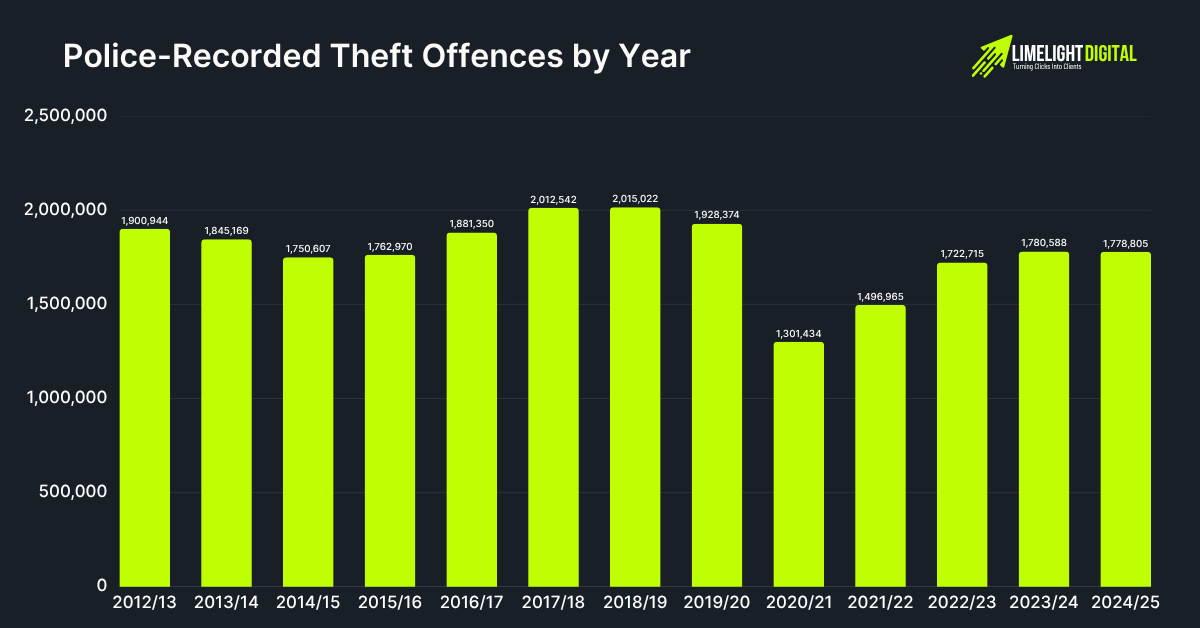
Below are the number of police recorded theft offences in England & Wales:
| Year | Offences |
|---|---|
| 2012/13 | 1,900,944 |
| 2013/14 | 1,845,169 |
| 2014/15 | 1,750,607 |
| 2015/16 | 1,762,970 |
| 2016/17 | 1,881,350 |
| 2017/18 | 2,012,542 |
| 2018/19 | 2,015,022 |
| 2019/20 | 1,928,374 |
| 2020/21 | 1,301,434 |
| 2021/22 | 1,496,965 |
| 2022/23 | 1,722,715 |
| 2023/24 | 1,780,588 |
| 2024/25 | 1,778,805 |
In 2024/25, there was an all-time high of shoplifting crimes reported to the police at 530,640. The increase in such crimes will affect not only retailers but also other businesses, such as those dealing in beauty products.
Source: Statista 3
UK Knife Crime Statistics
Knife crime continues to be among the most monitored categories. There have been 49,151 knife or sharp instrument offences reported by police during the year ending December 2025, representing a 10% drop from the previous year.
Levels remain 11% lower than the year ending March 2020, 55,170 offences. Increases between 2015 and 2020 were partly driven by improvements in police recording.
Here is a breakdown of knife crime offences by category from 2011 to 2025:
| Year | Assault with injury and assault with intent to cause serious harm | Robbery | Threats to kill | Other selected offences |
|---|---|---|---|---|
| Mar 2011 | 14647 | 17,187 | 1,424 | 762 |
| Mar 2012 | 13,130 | 16,978 | 1,172 | 724 |
| Mar 2013 | 11,839 | 13,692 | 1,155 | 617 |
| Mar 2014 | 12,203 | 12,451 | 1,295 | 745 |
| Mar 2015 | 13,836 | 11,025 | 1,696 | 843 |
| Mar 2016 | 16,187 | 11,496 | 2,297 | 947 |
| Mar 2017 | 19,455 | 14,329 | 2,918 | 1,109 |
| Mar 2018 | 21,765 | 19,138 | 3,385 | 1,227 |
| Mar 2019 | 22,821 | 21,226 | 3,954 | 1,341 |
| Mar 2020 | 22,873 | 22,727 | 4,746 | 1,636 |
| Mar 2021 | 20,589 | 14,842 | 4,790 | 1,451 |
| Mar 2022 | 22,610 | 15,657 | 5,551 | 1,754 |
| Mar 2023 | 22,169 | 18,807 | 5,779 | 1,649 |
| Dec 2024 | 21,740 | 21,733 | 5,618 | 1,981 |
| Dec 2025 | 20,127 | 18,382 | 5,892 | 1,860 |
Source: Crime in England and Wales
Knife-related homicides fell by 21% to 172 offences in the year ending December 2025. Hospital admissions for sharp object assaults also dropped 10% to 3,427 admissions.
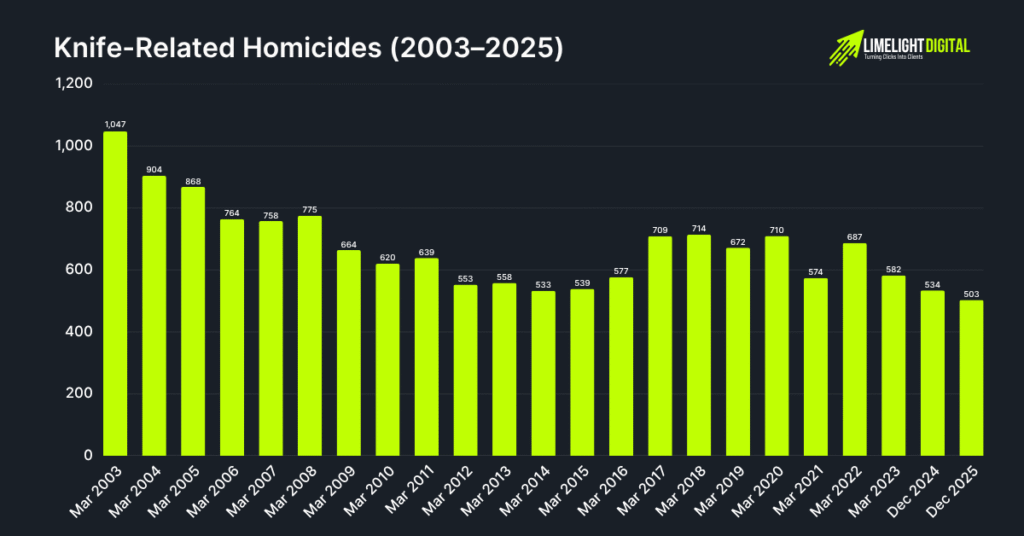
The following table tracks knife-related homicides in England and Wales from 2003 to 2025:
| Month & Year | Knife-related homicides |
|---|---|
| Mar 2003 | 1047 |
| Mar 2004 | 904 |
| Mar 2005 | 868 |
| Mar 2006 | 764 |
| Mar 2007 | 758 |
| Mar 2008 | 775 |
| Mar 2009 | 664 |
| Mar 2010 | 620 |
| Mar 2011 | 639 |
| Mar 2012 | 553 |
| Mar 2013 | 558 |
| Mar 2014 | 533 |
| Mar 2015 | 539 |
| Mar 2016 | 577 |
| Mar 2017 | 709 |
| Mar 2018 | 714 |
| Mar 2019 | 672 |
| Mar 2020 | 710 |
| Mar 2021 | 574 |
| Mar 2022 | 687 |
| Mar 2023 | 582 |
| Dec 2024 | 534 |
| Dec 2025 | 503 |
Source: Crime in England and Wales, Crime in England and Wales 2
The Metropolitan Police recorded the highest knife crime rate at 182 per 100,000 population in 2024/25. Cumbria Police recorded the lowest at 31 per 100,000. Urban forces consistently record far higher rates.
Source: House of Commons 1
Possession offences tell a separate story. Police recorded 28,596 “possession of an article with a blade or point” offences in the year ending September 2025, a 1% increase.
Source: Crime in England and Wales 2
UK Violent Crime Statistics
The CSEW estimated around 1.1 million incidents of violence with or without injury in the year ending March 2025. There was no statistically significant change from the previous year.
Source: Crime in England and Wales
Police recorded 520,071 violent injury offences in the year ending March 2025, a 7% decrease. Violence without injury remained stable at 817,525 offences.
An estimated 145,271 people attended emergency units across England and Wales for treatment of violence-related injuries in the year ending December 2024. That figure is still 31% lower than in 2014.
Source: The World Data
Homicides decreased to 503 offences in the year ending December 2025. The homicide rate was 8.1 per million people, down from 8.9 the previous year.
Source: Crime in England and Wales
UK Gun Crime Statistics
Police recorded 4,753 firearms offences excluding air weapons in the year ending March 2025, a 9% decrease from the previous year.
That figure represents the lowest level since 2015, when 4,911 offences were recorded. The decline continues a long-term downward trend from the peak of 11,088 offences in 2006.
The table below shares firearms offence data broken down by weapon type over two decades:
| Year | All firearms | Shotguns | Handguns | Rifles | Imitation firearms | Unidentified firearms | Other firearms |
|---|---|---|---|---|---|---|---|
| Mar 2003 | 10248 | 672 | 5549 | 52 | 1814 | 1431 | 730 |
| Mar 2004 | 10338 | 718 | 5144 | 48 | 2146 | 1356 | 926 |
| Mar 2005 | 11069 | 597 | 4360 | 54 | 3373 | 1500 | 1185 |
| Mar 2006 | 11088 | 642 | 4672 | 71 | 3277 | 1362 | 1064 |
| Mar 2007 | 9645 | 612 | 4173 | 69 | 2516 | 1276 | 999 |
| Mar 2008 | 9865 | 602 | 4172 | 71 | 2561 | 1325 | 1134 |
| Mar 2009 | 8199 | 618 | 4273 | 89 | 1507 | 953 | 759 |
| Mar 2010 | 8082 | 581 | 3757 | 67 | 1526 | 1368 | 783 |
| Mar 2011 | 7040 | 611 | 3107 | 74 | 1618 | 958 | 672 |
| Mar 2012 | 6022 | 494 | 2655 | 56 | 1387 | 834 | 596 |
| Mar 2013 | 5158 | 453 | 2256 | 43 | 1226 | 724 | 456 |
| Mar 2014 | 4856 | 387 | 2134 | 55 | 1142 | 698 | 440 |
| Mar 2015 | 4911 | 431 | 2061 | 52 | 1123 | 833 | 411 |
| Mar 2016 | 5182 | 411 | 2157 | 48 | 1431 | 666 | 469 |
| Mar 2017 | 6375 | 592 | 2685 | 61 | 1642 | 844 | 551 |
| Mar 2018 | 6530 | 654 | 2867 | 92 | 1540 | 869 | 508 |
| Mar 2019 | 6881 | 687 | 2763 | 67 | 1445 | 1172 | 747 |
| Mar 2020 | 6665 | 633 | 2629 | 74 | 1526 | 989 | 814 |
| Mar 2021 | 5744 | 537 | 2133 | 57 | 1456 | 938 | 623 |
| Mar 2022 | 5771 | 441 | 1799 | 58 | 1933 | 1061 | 479 |
| Mar 2023 | 6060 | 442 | 1919 | 52 | 2217 | 978 | 452 |
| Dec 2024 | 5241 | 346 | 1793 | 66 | 1882 | 797 | 357 |
| Dec 2025 | 4753 | 315 | 1479 | 76 | 1829 | 692 | 362 |
Source: Crime in England and Wales
Geographically, the Metropolitan Police recorded the largest share of firearms offences at 22% of the national total. However, Bedfordshire Police had the highest rate at 18.0 per 100,000 population.
Source: House of Commons 3
UK Hate Crime Statistics
The Home Office recorded 137,550 hate crimes in England and Wales in the year ending March 2025. Excluding the Metropolitan Police, whose data is not directly comparable due to a system change, there were 115,990 offences.
Excluding the MPS, hate crimes rose 2% compared with the previous year. Race hate crimes increased 6%, and religious hate crimes increased 3%. Sexual orientation, disability, and transgender hate crimes all fell.
Race hate crimes accounted for 71% of all hate crimes, at 82,490 offences. That figure was still below the peak of 87,905 offences recorded in the year ending March 2022.
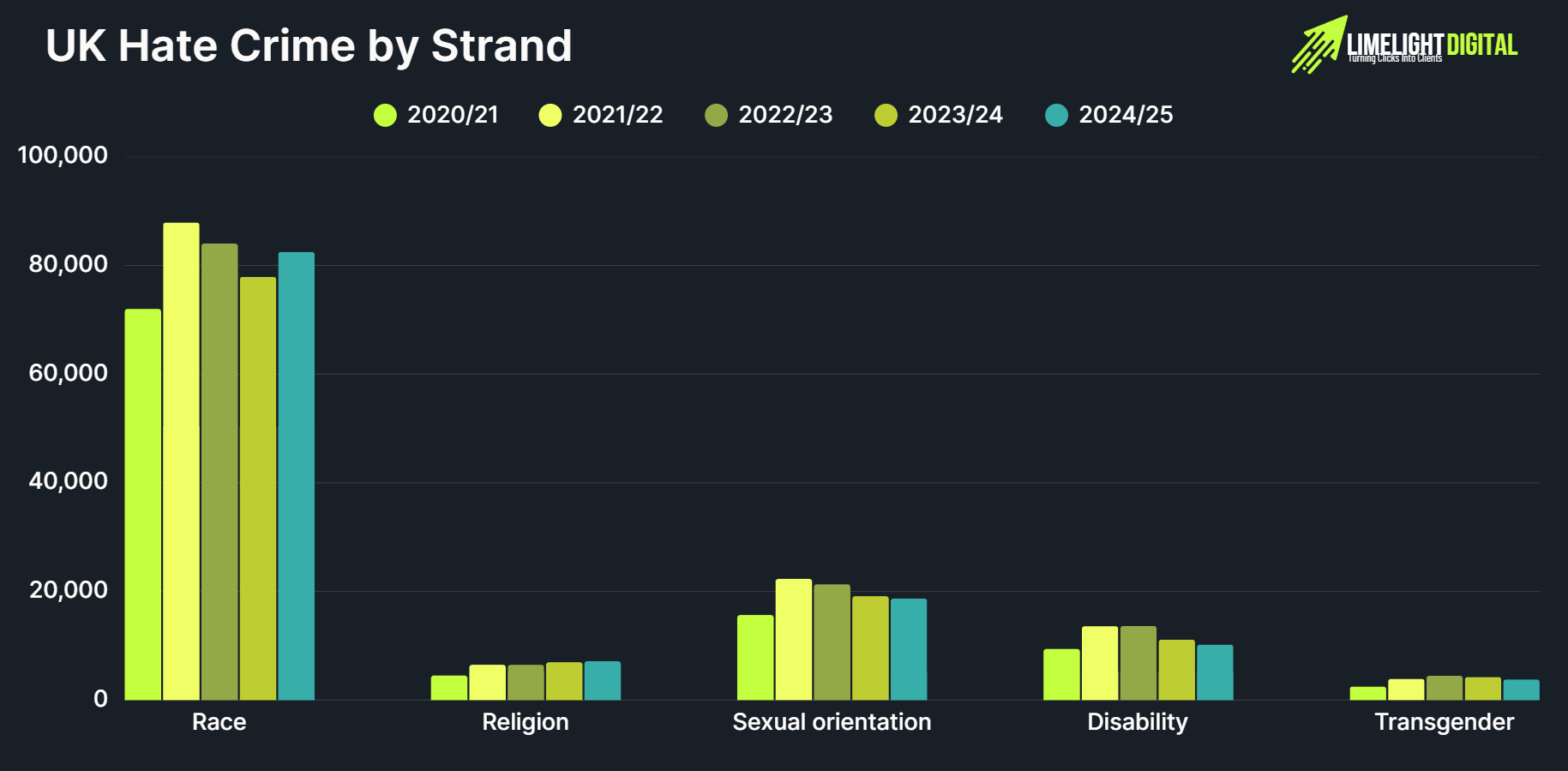
Here is a table displaying hate crime offences in England and Wales by category from 2020 to 2025:
| Hate crime strand | 2020/21 | 2021/22 | 2022/23 | 2023/24 | 2024/25 |
|---|---|---|---|---|---|
| Race | 71,995 | 87,905 | 84,039 | 77,901 | 82,490 |
| Religion | 4,527 | 6,510 | 6,513 | 6,973 | 7,164 |
| Sexual orientation | 15,668 | 22,317 | 21,306 | 19,127 | 18,702 |
| Disability | 9,418 | 13,611 | 13,637 | 11,131 | 10,224 |
| Transgender | 2,510 | 3,920 | 4,477 | 4,258 | 3,809 |
Religious hate crimes against Muslims surged 19% from 2,690 to 3,199 offences. A clear spike occurred in August 2024, following the Southport murders and subsequent disorder.
Source: UK Gov 4
UK Crime Statistics by Postcode
At the postcode level, Camden postcodes N1, NW1 to NW8, WC1, and WC2 recorded nearly 195 offences per 1,000 people, making it the area with the highest crime rate in Great Britain.
Sutton postcodes SM1 to SM7 scored highest for safety at 8.09 out of 10, with just 61 offences per 1,000 people and a below-average reoffending rate.
The table below ranks UK local authorities by their safety score out of 10:
| Local Authority | Safety Score /10 |
|---|---|
| Sutton | 8.09 |
| Telford and Wrekin | 8 |
| Kingston upon Thames | 7.81 |
| Dundee | 7.66 |
| Richmond upon Thames | 7.55 |
| Swindon | 7.13 |
| Hounslow | 7.08 |
| Slough | 7.07 |
| Redbridge | 7.03 |
| Barnet | 7.02 |
Source: Get Licensed