
The international beauty market keeps on growing, with new digital trends, a change of consumption habits, and robust growth in the skin and personal care sector. Valued at $698.38 billion in 2026, the industry shows steady growth over traditional physical channels and e-commerce alike as it plays a more central role in its respective supply chains. So too do growing employment levels and rapidly improving beauty tech.
This article covers important statistics, market trends, top brands, and future growth opportunities shaping the industry.
Top Beauty Industry Statistics
- The global beauty and personal care market is expected to reach $698.38 billion by 2026.
- Skincare holds roughly 40% of the total beauty market value.
- Beauty tech is forecast to grow to $177.67 billion by 2030 at a rapid pace.
- The UK beauty sector employed ~496,000 people in 2024, up 11% year on year.
- Social media influences around 70% of beauty product discovery among users.
How Much Is The Cosmetic Industry Worth
The worldwide Beauty & Personal Care industry is projected to reach $698.38 billion in revenue by 2026, with an annual growth rate of 3.16% between 2026 and 2031. Within this vast market, the Personal Care segment is expected to dominate, accounting for an estimated market volume of $302.98 billion in 2026.
When comparing the global landscape, the United States emerges as the frontrunner in revenue generation, with a projected contribution of $107 billion by 2026. On a per capita basis, the global market is expected to generate $88.36 per person in the same year.
Moreover, the digital revolution is set to play a significant role in the Beauty & Personal Care market, with online sales projected to account for an impressive 30.6% of the total revenue by 2026.
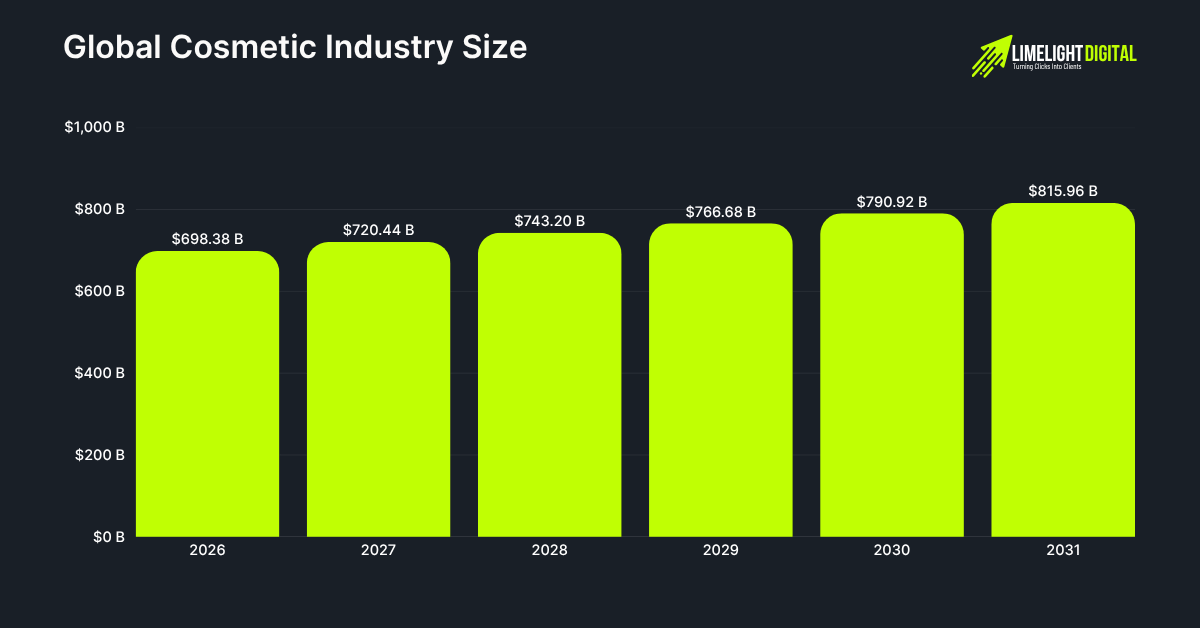
The table below shows the estimated growth of the beauty industry market:
| Year | Estimated Market Size |
|---|---|
| 2026 | $698.38 billion |
| 2027* | $720.44 billion |
| 2028* | $743.20 billion |
| 2029* | $766.68 billion |
| 2030* | $790.92 billion |
| 2031* | $815.96 billion |
*Predicted
Source: Statista
UK Cosmetics Market
The United Kingdom’s cosmetics industry is poised for significant growth, with projections indicating that it will amass a revenue of $17.5 million by the year 2033. From 2026 to 2033, the UK cosmetics market is anticipated to experience a robust compound annual growth rate (CAGR) of 6.1%, showcasing its strong potential for expansion.
In the global context, the United Kingdom held a notable position in the cosmetics market in 2025, accounting for 3.3% of the worldwide revenue. This highlights the country’s significant contribution to the industry on an international scale.
Among the European markets, France emerges as the most rapidly growing region, with forecasts suggesting that it will achieve a substantial revenue of $15.0 million by 2033. This impressive growth underscores France’s pivotal role in driving the cosmetics industry forward within the European continent.
Within the cosmetics market, the skin care segment emerged as the dominant force in 2025, capturing a substantial 45.45% share of the total revenue.
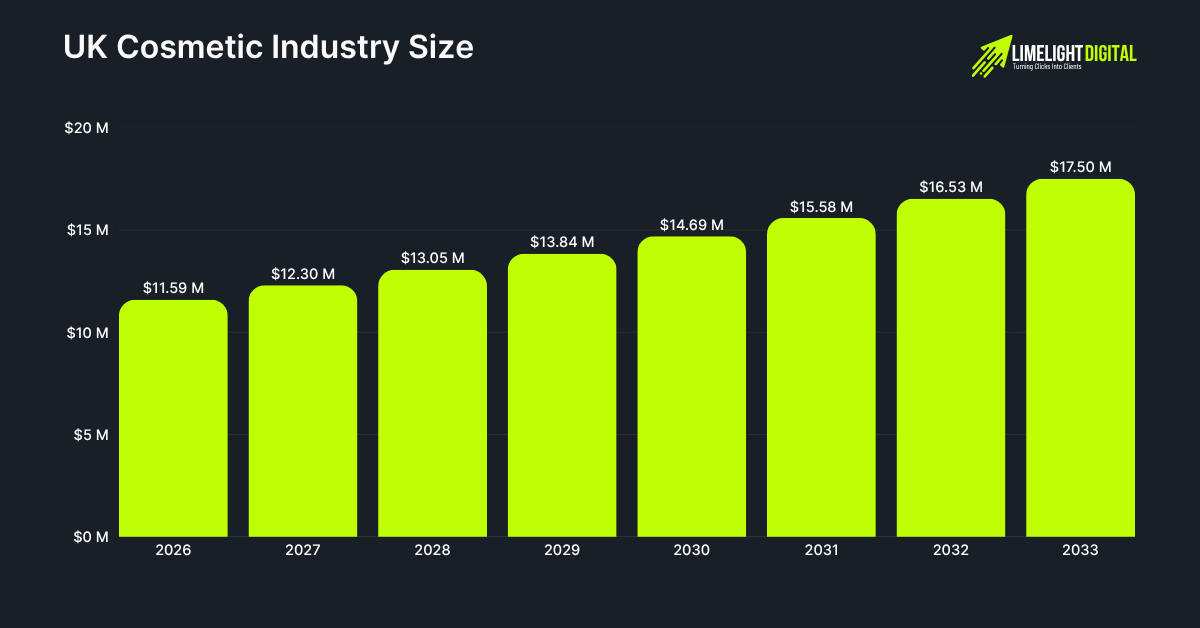
Have a look at the UK beauty market growth shown below:
| Year | Market Size |
|---|---|
| 2026 | $11.59 million |
| 2027 | $12.30 million |
| 2028 | $13.05 million |
| 2029 | $13.84 million |
| 2030 | $14.69 million |
| 2031 | $15.58 million |
| 2032 | $16.53 million |
| 2033 | $17.50 million |
Source: Grand View Research
Biggest Beauty Brands In The World
The global beauty industry is dominated by giants like L’Oréal, which achieved €44.05 billion in sales in 2025, and Estée Lauder, which reported $14.33 billion in net sales for the fiscal year ending June 30, 2025, an 8% decline from the previous year.
Other major players include Unilever, Procter & Gamble, Shiseido, Coty, Johnson & Johnson, Beiersdorf, Amorepacific, and Chanel, each commanding significant global market share across skincare, cosmetics, and fragrances.
| # | Brand | Origin | Key Products / Notes |
|---|---|---|---|
| 1 | L’Oréal | France | Maybelline, Garnier, Lancôme |
| 2 | Estée Lauder | USA | MAC, Clinique, Bobbi Brown |
| 3 | Unilever | UK/Netherlands | Dove, Sunsilk, Pond’s |
| 4 | Procter & Gamble | USA | Olay, SK-II, Head & Shoulders |
| 5 | Shiseido | Japan | One of the oldest beauty companies |
| 6 | Coty | USA/France | Fragrances, cosmetics, skincare |
| 7 | Johnson & Johnson | USA | Neutrogena, Aveeno |
| 8 | Beiersdorf | Germany | Nivea, Eucerin |
| 9 | Amorepacific | South Korea | Laneige, Innisfree |
| 10 | Chanel | France | Luxury beauty, skincare, fragrances |
Beauty Industry Trends
In the first half of 2025, the US beauty market grew to $50.6 billion, prestige beauty at $16 billion (+2%) and mass-market sales at $34.6 billion (+4%), per Circana. Masstige brands led skincare with double-digit growth.
Source: BeautyMatter
Skincare represents approximately 40% of the total beauty market value. The global skincare market was valued at $162.11 billion in 2025 and is projected to reach $222.07 billion by 2030.
Source: Tricoci University
Beauty tech encompassing AI personalization, AR try-ons, and smart skincare devices was valued at $66.16 billion in 2024 and is projected to reach $172.99 billion by 2030 at a 17.9% CAGR. AI is the fastest-growing technology segment.
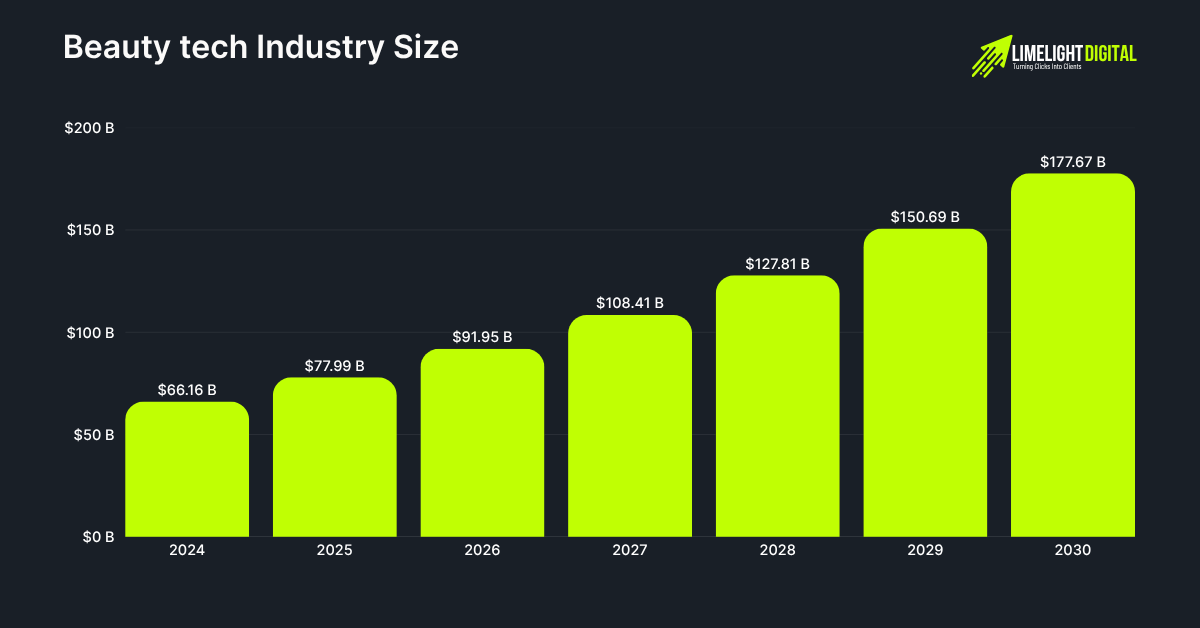
The beauty tech industry is projected to grow, as shown in the table below:
| Year | Market Size |
|---|---|
| 2024 | $66.16 billion |
| 2025 | $77.99 billion |
| 2026 | $91.95 billion |
| 2027 | $108.41 billion |
| 2028 | $127.81 billion |
| 2029 | $150.69 billion |
| 2030 | $177.67 billion |
Source: Grand View Research
Beauty Industry Employment And Workforce Statistics
The Bureau of Labor Statistics projects 5% employment growth for barbers, hairstylists, and cosmetologists from 2024 to 2034, faster than the average for all occupations, with approximately 84,200 job openings per year.
Source: SBDCNet
Skincare specialist roles are projected to grow 17%, and manicurist/pedicurist positions are forecast to grow 22% between 2021 and 2031, both outpacing overall US employment growth of 5%.
Source: PBA
The beauty and personal care industry in the EU directly provided about 2 million jobs (comparable to the real estate sector) and supported ~3.2 million jobs total through its value chain.
Source: The Value Of Beauty
In the UK, the beauty sector directly employed ~496,000 people in 2024, an 11% year‑on‑year increase.
Source: BBC
Beauty Industry Advertising And Marketing Spend Statistics
In 2026, total beauty advertising expenditure is projected to hit $11.4 billion globally, with programmatic digital advertising accounting for 48% of that spend, up from 34% in 2022.
TikTok Shop processed over $3.4 billion in beauty-related transactions in Q1 2026 alone, a 41% year-over-year increase.
Source: Amra & Elma
L’Oreal has spent more than $2 billion in advertising every year since 2017. Ulta Beauty spent close to about $375 million on advertising in 2022. Over $4 billion was spent on ads in the cosmetics and personal care industry in 2021 in the U.S.
Source: Statista
29% of US adults say they will likely cut back on beauty and personal care spending if tariffs raise prices, per CivicScience (February 2025), signalling that trade policy is a live risk to marketing-driven growth projections.
Source: EMarketer
Beauty’s social return on ad spend (ROAS) dipped to $1.90 in Q4 2024 before rebounding sharply to $3.50 in Q1 2025, reflecting improved campaign efficiency as brands refined their social-commerce strategies.
Source: EMarketer
Social media is instrumental in helping people discover new beauty products; about 70% of users, especially among the younger audience who spend ample hours online, use social media to explore products.
Source: Cropink