
The nature of productivity is being redefined by the rise of Artificial Intelligence in the work culture of 2026. Its effectiveness on productivity and efficiency cannot be denied, as 88% of organisations now use AI in at least one business function. Whether it’s automating workflows or improving decision-making, AI is quickly becoming a central driver of value creation across industries.
This article explores key AI efficiency statistics, adoption trends, productivity gains, and challenges shaping the global AI landscape.
Top AI Efficiency Statistics (Quick Highlights)
- AI is used by 88% of organisations in at least one function.
- AI users save an average 5.4% work hours weekly globally.
- Generative AI delivers up to 84% time savings per task.
- The global AI market is expected to reach $3.4 trillion by 2033.
- 42% of jobs are potentially exposed to AI automation risks.
- Data quality is cited by 52% as the biggest AI adoption challenge.
AI Adoption Statistics
16.3% of the global population actively used generative AI tools in H2 2025 (up from 15.1% in H1 2025).
Source: Microsoft
The UAE leads global AI adoption at 64.0% of its working-age population, followed by Singapore at 60.9% and Norway at 46.4%. The UK, on the other hand, ranks 9th with 38.9%.
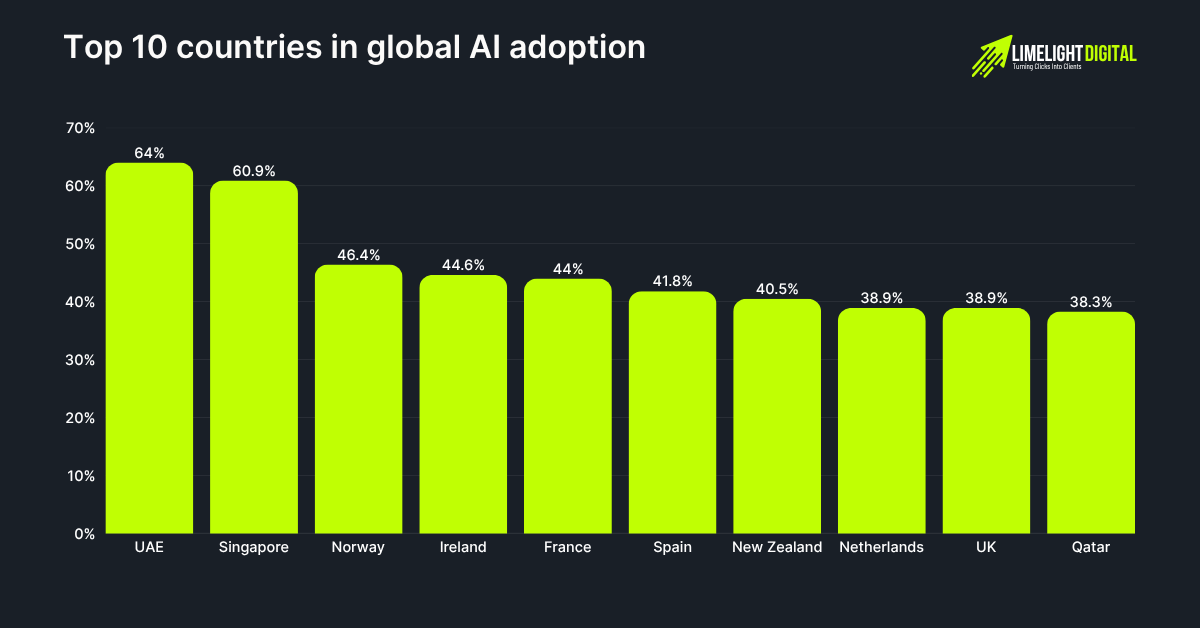
Below are the top countries with the highest AI adoption
| Rank | Country | Share of Working-Age Population Using AIH2 2025 | Change vsH1 2025 (p.p.) |
|---|---|---|---|
| 1 | UAE | 64% | 4.6 |
| 2 | Singapore | 60.9% | 2.3 |
| 3 | Norway | 46.4% | 1.1 |
| 4 | Ireland | 44.6% | 2.9 |
| 5 | France | 44% | 3.1 |
| 6 | Spain | 41.8% | 2.1 |
| 7 | New Zealand | 40.5% | 2.9 |
| 8 | Netherlands | 38.9% | 2.6 |
| 9 | UK | 38.9% | 2.5 |
| 10 | Qatar | 38.3% | 2.6 |
The United States ranks 24th globally in population-level AI usage, with just 28.3% adoption among working-age adults, despite leading in infrastructure and frontier model development.
Source: Visual Capitalist
88% of organisations globally reported using AI in at least one business function in 2025, up from 20% in 2017.
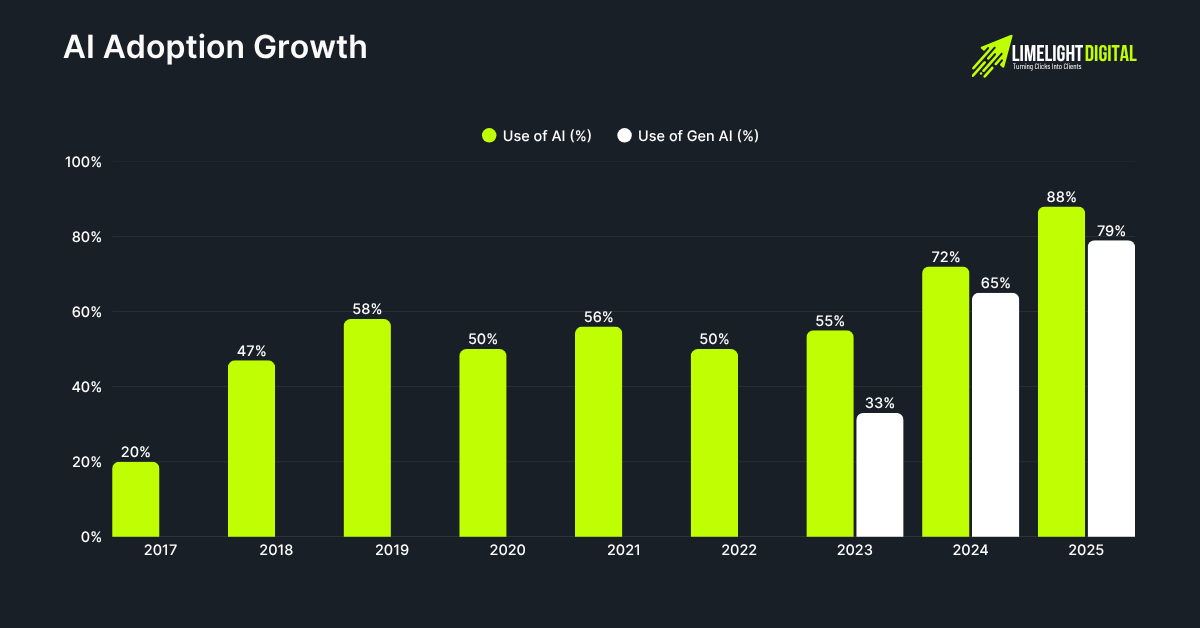
Below is the rise in usage of AI and gen AI:
| Year | Use of AI (%) | Use of Gen AI (%) |
|---|---|---|
| 2017 | 20% | – |
| 2018 | 47% | – |
| 2019 | 58% | – |
| 2020 | 50% | – |
| 2021 | 56% | – |
| 2022 | 50% | – |
| 2023 | 55% | 33% |
| 2024 | 72% | 65% |
| 2025 | 88% | 79% |
Source: McKinsey
OECD firm-level AI adoption more than doubled in two years: from 8.7% in 2023 → 14.2% in 2024 → 20.2% in 2025.
Source: OECD
20.0% of EU enterprises used AI in 2025, up from 13.5% in 2024. Large EU enterprises (250+ employees) adoption stood at 55.03%, versus just 17% for small enterprises.
Source: Eurostat
20% of the organisations surveyed by McKinsey are using AI in 5 or more business functions.
Source: McKinsey
AI Efficiency And Productivity Statistics
- AI users saved an average of 5.4% of their work hours per week (approximately 2.2 hours in a 40-hour week). One-third of daily AI users reported saving at least 4 hours per week.
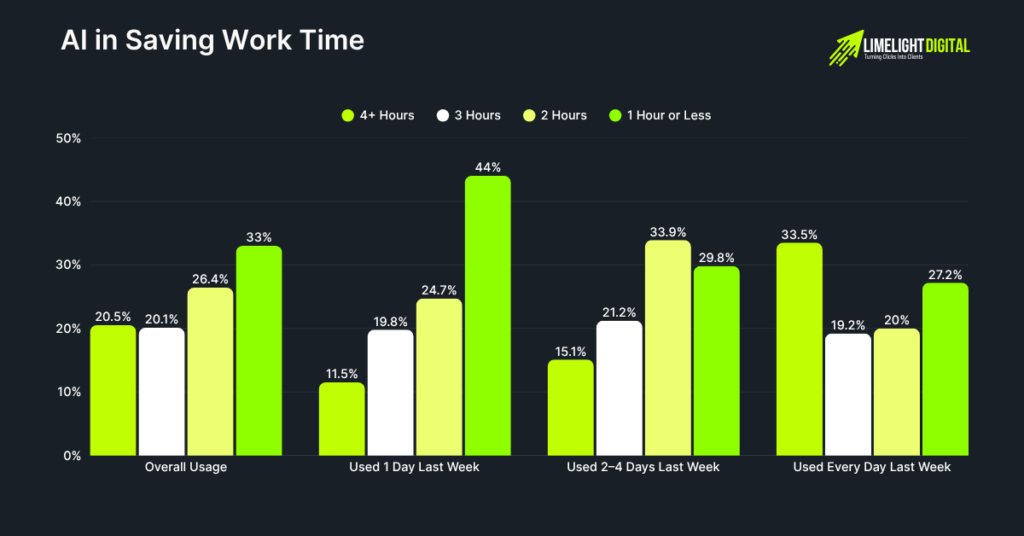
Usage by hours in a workweek is mapped below:
| Usage Category | 4+ Hours | 3 Hours | 2 Hours | 1 Hour or Less |
|---|---|---|---|---|
| Overall Usage | 20.50% | 20.10% | 26.40% | 33.00% |
| Used 1 Workday in the previous week | 11.50% | 19.80% | 24.70% | 44.00% |
| Used 2–4 Workdays in the previous week | 15.10% | 21.20% | 33.90% | 29.80% |
| Used Every Workday in the Previous Week | 33.50% | 19.20% | 20.10% | 27.20% |
Source: Federal Reserve
- Anthropic’s Economic Index found that the median AI-assisted conversation produced an estimated 84% time savings compared to completing the same task without AI. The distribution peaks between 80-90% time savings.
Source: Anthropic
- Self-reported time savings from generative AI correspond to 1.6% of all U.S. work hours in early 2025, implying a 1.3% labor productivity boost since ChatGPT’s launch.
Source: The Hill
- 75% of global knowledge workers were using AI tools regularly in 2025. Among those, 93% of executives at high-AI-usage companies favour a four-day workweek, versus fewer than 50% at low-AI companies.
Source: Worklytics
- In a large customer support experiment with 5,000 agents, AI assistance increased issues resolved per hour by 14%, with the biggest gains seen among novice workers.
Source: The Hill
- A professional writing experiment found that ChatGPT access cut task completion times by roughly 40% and improved quality scores by double digits.
Source: The Hill
- AI email management tools reduced email processing time by 25% in a six-month controlled field experiment.
Source: Worklytics
- Penn Wharton Budget Model estimates AI will increase U.S. productivity and GDP by 1.5% by 2035, nearly 3% by 2055, and 3.7% by 2075.
| Year | Estimated Increase in U.S. Productivity & GDP |
|---|---|
| 2035 | 1.50% |
| 2055 | ~3.0% |
| 2075 | 3.70% |
- Around 42% of current jobs are potentially exposed to AI automation (at least 50% of tasks automatable).
Source: Penn Wharton
- 66% of organisations surveyed by Deloitte confirmed AI is delivering on efficiency and productivity, and twice as many leaders as last year reported a transformative business impact.
Source: Deloitte
AI In Business And Marketing Efficiency
- Deloitte 2026 reports that the number of companies with 40% or more of AI projects in production is set to double within six months. Worker access to AI rose 50% in 2025 alone.
Source: Deloitte
- 56% of business leaders who achieved positive ROI from AI investments report that it translated into significant measurable improvements in overall financial performance.
Source: EY
- In financial services, global annual AI spending exceeded $20 billion in 2025. 68% of hedge funds now employ AI for market analysis and trading strategies. Robo-advisors manage over $1.2 trillion in assets globally.
- AI tools now reach 378 million people worldwide in 2025, representing a gain of 64 million new users since 2024, the largest year-on-year jump ever recorded.
Source: Netguru
- In the 2023–2024 stretch, use of generative AI in organisations jumped from 55% to 75%, with companies reporting a 3.7x ROI for every dollar invested in GenAI.
Source: Coherent
- 81% of workers collaborating with AI reported higher job satisfaction. 23% of employees now delegate tasks to AI agents to boost efficiency.
Source: Salesforce
- AI recruitment field experiment: AI-led interviews increased job offers by 12%, job-start rates by roughly 18%, and 30-day retention by approximately 18% relative to human-conducted interviews.
Source: ICLE
- Only 34% of organisations are truly reimagining their business around AI, and 74% still aspire to grow revenue through AI.
Deloitte State of AI 2026
AI Growth And Market Size Statistics
The global AI market was valued at $390.91 billion in 2025 and is expected to reach $539.45 billion in 2026, with a CAGR of 30.6% through 2033, ultimately reaching $3.49 trillion by 2033.
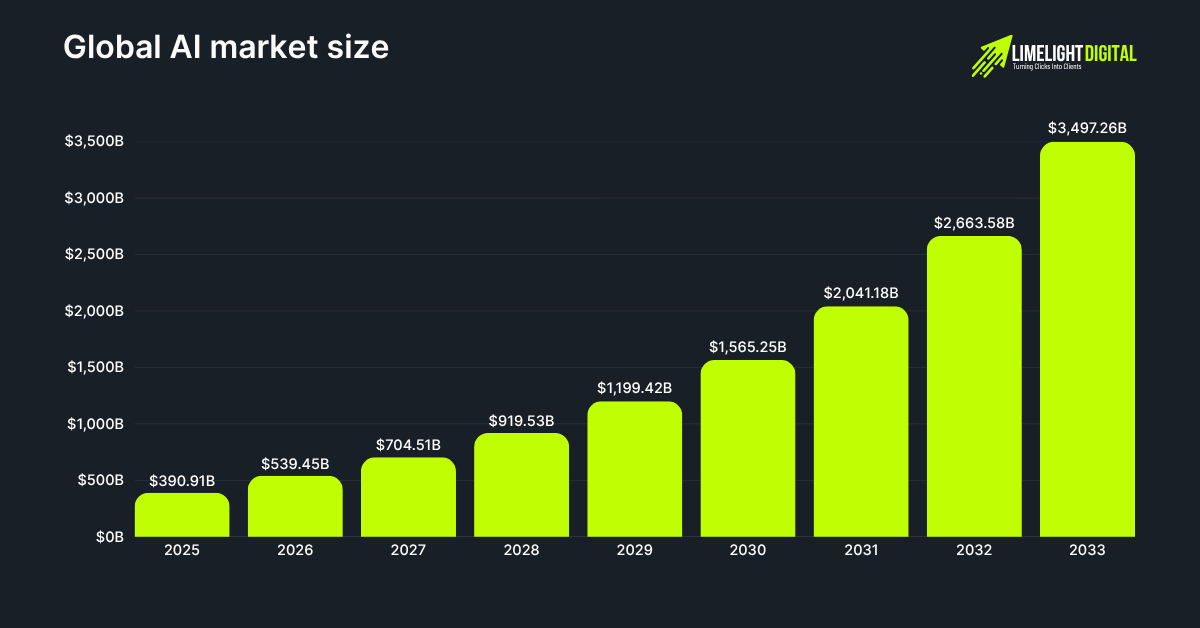
You can see the projected growth of the AI market below:
| Year | Market Size |
|---|---|
| 2025 | $390.91 billion |
| 2026 | $539.45 billion |
| 2027 | $704.51 billion |
| 2028 | $919.53 billion |
| 2029 | $1,199.42 billion |
| 2030 | $1,565.25 billion |
| 2031 | $2,041.18 billion |
| 2032 | $2,663.58 billion |
| 2033 | $3,497.26 billion |
Source: Grand View Research
Economic Impact Of AI Efficiency
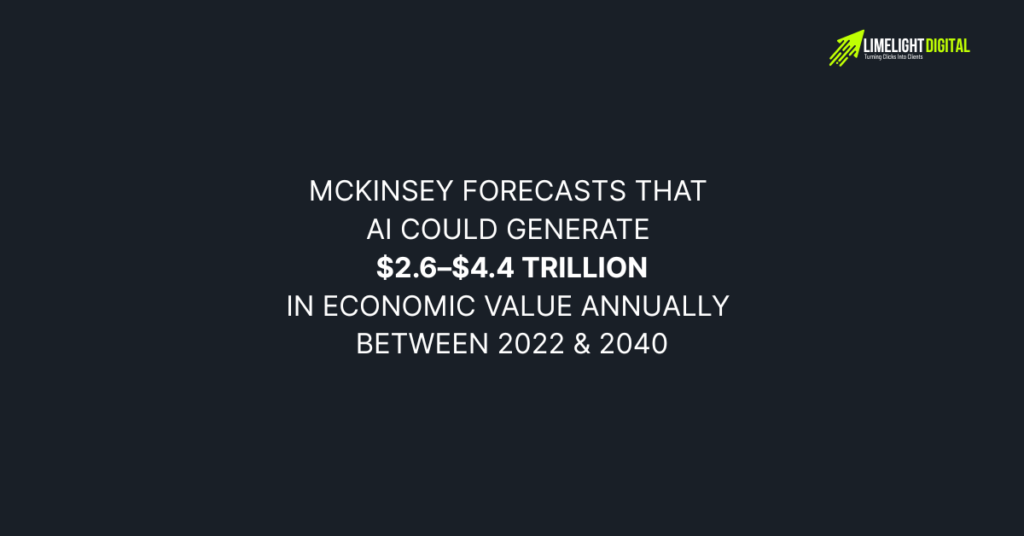
- McKinsey Global Institute projects that generative AI could generate $2.6–$4.4 trillion in economic value annually.
Source: MIT FutureTech
- Goldman Sachs estimates generative AI may raise global GDP by $7 trillion (7%) over the next decade, lifting annual productivity growth by 1.5 percentage points.
Source: Goldman Sachs
- PwC’s long-range estimate places AI’s contribution at $15.7 trillion to global GDP by 2030, representing approximately 14% of total global GDP.
Source: WEF
- Goldman Sachs found a median reported productivity gain of around 30% for two specific localised use cases (software development and customer service), even as economy-wide impacts remain elusive.
Source: Fortune
- Goldman Sachs chief economist Jan Hatzius stated that AI investment contributed ‘basically zero’ to officially measured U.S. GDP growth in 2025. Adjusted ‘true GDP’ impact is estimated at $160 billion (0.7% of GDP) since 2022, versus just $45 billion officially counted.
Source: Yahoo Finance 1, Yahoo Finance 2
- AI investments in 2025 reached $225.8 billion, with AI companies accounting for 58% of all capital invested and 36% of total deals in the United States.
Source: State of AI
AI Energy Consumption And Efficiency Trade-Offs
- Global data centers consumed approximately 415 TWh of electricity in 2024, representing about 1.5% of global electricity consumption. Data center consumption has grown 12% per year since 2017, more than four times faster than total electricity demand growth.
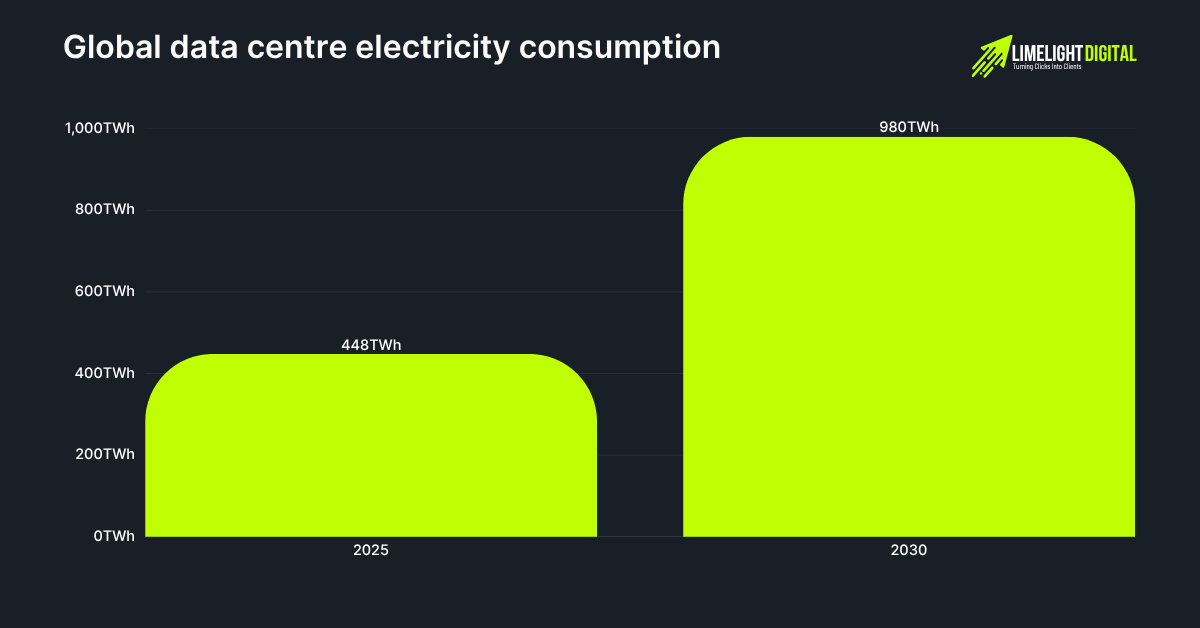
- The IEA’s base case projects global data centre electricity consumption will double to approximately 945 TWh by 2030, slightly more than Japan’s total electricity consumption today.
Source: IEA
- Gartner estimates worldwide data centre electricity consumption will rise from 448 TWh in 2025 to 980 TWh by 2030. AI-optimised server electricity usage is set to rise nearly fivefold, from 93 TWh in 2025 to 432 TWh in 2030. In 2025, AI-optimised servers represent 21% of total data centre power.
Source: Gartner
- U.S. data centres consumed 183 TWh of electricity in 2024, more than 4% of the country’s total electricity consumption, roughly equivalent to the annual demand of the entire nation of Pakistan. By 2030, this figure is projected to grow by 133% to 426 TWh.
Source: Pew
- A typical AI-focused data center consumes as much electricity as 100,000 households. The largest ones currently under construction are expected to use 20 times as much.
Source: IEA
- Data center growth accounted for an estimated $9.3 billion price increase in the PJM electricity capacity market for 2025–26, adding approximately $18/month to household electricity bills in parts of Ohio and western Maryland.
Source: IEEFA
- The U.S. EIA projects commercial computing electricity consumption will grow from 8% of the commercial sector in 2024 to 20% by 2050, potentially surpassing lighting and space cooling.
Source: U.S. EIA
- Ireland’s data centers already consume about 21% of national electricity, forecast to reach 32% by 2026. Virginia (U.S.) data centers consume 26% of the state’s electricity.
Source: AI Multiple
Challenges Affecting AI Efficiency
- Data quality and availability are the single biggest challenge: 52% of business professionals cited it as the top AI adoption barrier in the PEX Report 2025/26, based on a survey of over 200 professionals.
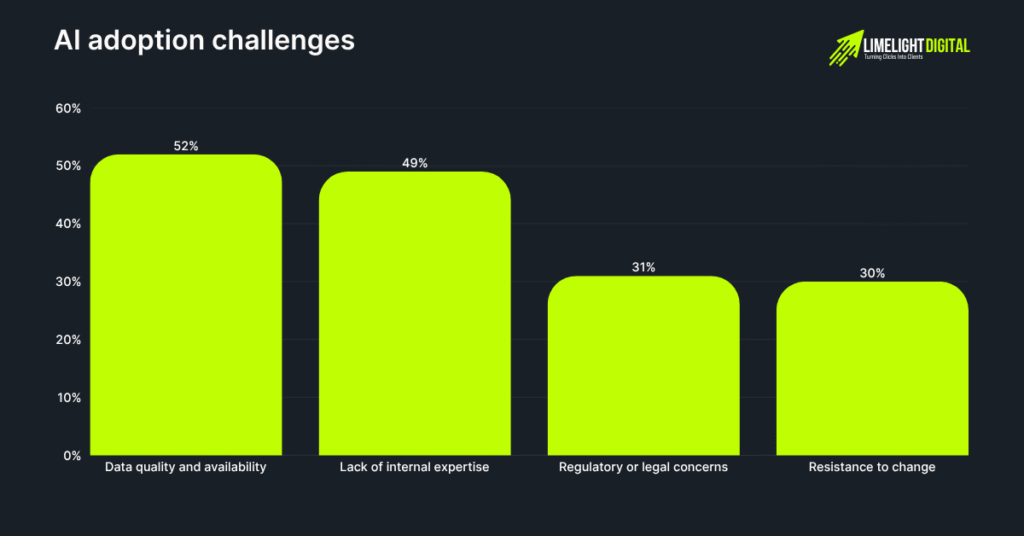
Belo are some challenges in AI efficiency mapped out:
| Challenge | Percentage (%) |
|---|---|
| Data quality and availability | 52% |
| Lack of internal expertise | 49% |
| Regulatory or legal concerns | 31% |
| Resistance to change | 30% |
Source: PEX
- The AI skills gap is seen as the biggest barrier to integration per Deloitte’s 2026 survey. Education, not role or workflow redesign, was the No. 1 way companies adjusted their talent strategies due to AI. Only 42% of companies believe their strategy is highly prepared for AI adoption.
Source: Deloitte
- 49% of organizations say they would be in a stronger position if they had better employee training programs; 48% cite data infrastructure as the key improvement needed. 32% cite access to talent as the critical gap.
- Only 34% of organizations’ AI initiatives are fully aligned with overall business goals. 18% of organizations report that their AI initiatives are not aligned with business goals at all.
Source: PEX