
Outsourcing has grown from a just cost-cutting utility into a strategic growth engine. Its global market is expected to touch $1.35 trillion by 2031. Companies are increasingly using external partners not just for back-office efficiency but also for innovation, customer experience, and many other requirements.
We have collected some of the key market dynamics, adoption statistics, geographical trends, and future outlook shaping the global outsourcing outlook in this article.
Outsourcing Statistics 2026 (Top Picks)
- The global outsourcing market is expected to reach $1.35 trillion by 2031.
- The broader outsourcing market is projected to be $7.11 trillion by 2030.
- 80% executives are increasing outsourcing, 67% prefer outcome-based partnerships.
- 77% of businesses outsource IT functions globally.
- 92% organizations expect AI integration from outsourcing providers.
Global Outsourcing Market Size And Growth
The global outsourcing services market stands at $1.09 trillion in 2025 and is forecast to reach $1.35 trillion by 2031, at a 5.77% CAGR.
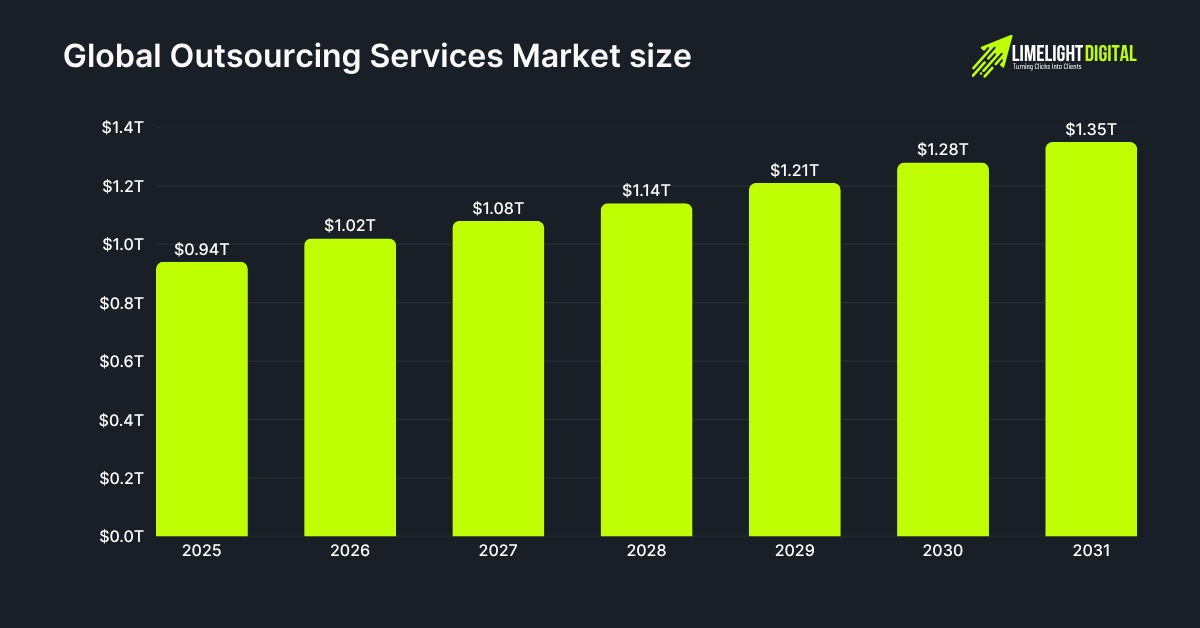
Below is the projected growth of the global outsourcing market:
| Year | Market Size |
|---|---|
| 2025 | $0.94 trillion |
| 2026 | $1.02 trillion |
| 2027 | $1.08 trillion* |
| 2028 | $1.14 trillion* |
| 2029 | $1.21 trillion* |
| 2030 | $1.28 trillion* |
| 2031 | $1.35 trillion* |
*Estimated Values
Source: Mordor Intelligence
Broader estimates, including engineering services, put the market at $3.8 trillion in 2024, projected at $7.11 trillion by 2030 at an 11.3% CAGR.
Source: Grand View Research
The global IT services outsourcing market was $661.96 billion in 2025 and is forecast to reach $1,345.48 billion by 2034 at a CAGR 8.20%.
Source: Precedence Research
North America led the outsourcing services market with 42.66% revenue share in 2025, and Asia-Pacific is the fastest-growing region at 7.99% CAGR through 2031.
Source: Mordor Intelligence
The UK outsourcing services market generated $219.5 billion in 2024, forecast to reach $387.3 billion by 2030 at a 10.2% CAGR, above the global average.
Source: Grand View Research
Outsourcing Adoption Statistics
Outsourcing is no longer just a cost-cutting tactic; it’s becoming a core part of how modern businesses operate and grow.
Recent insights from Deloitte show that most executives are doubling down on outsourcing.
In fact, 80% of leaders surveyed in 2024 said they plan to either maintain or increase their investment in third-party providers. But what’s really changing is how they outsource. Around 67% are now moving toward outcome-based partnerships, focusing on results rather than simply adding external staff to their teams.
Interestingly, outsourcing is no longer limited to back-office functions. About half of executives now rely on external partners for front-office capabilities like sales, marketing, and even R&D, areas that were once considered too strategic to outsource.
At the same time, companies aren’t blindly outsourcing everything. Around 70% of organizations have actually brought some previously outsourced work back in-house over the past five years. The goal here isn’t to reverse outsourcing, but to strike the right balance and strengthen internal capabilities where it matters most.
Source: Deloitte
Data from Doit reinforces this trend. Among Global 2000 companies, 57% use outsourcing in some form. Of those, a massive 92% outsource IT services, while 59% outsource business processes. And the momentum is still building; more than half (56%) of companies that already outsource say they plan to increase their investment, compared to just 14% who expect to scale back.
Source: Doit
Looking at regional trends, outsourcing remains especially strong in the UK. According to Exploding Topics, 34% of B2B organizations outsource IT support, making it the most commonly outsourced function. Meanwhile, the CBI reports that 35% of the UK’s top IT-spending organizations were planning to increase their IT outsourcing over the following two years.
Source: Exploding Topics, CBI
Small Business Outsourcing Statistics
37% of small businesses globally outsource at least one business process, demonstrating increasing accessibility for smaller firms.
Source: Clutch
52% of small businesses regularly use a professional firm or agency for outsourcing, according to dedicated SME outsourcing surveys.
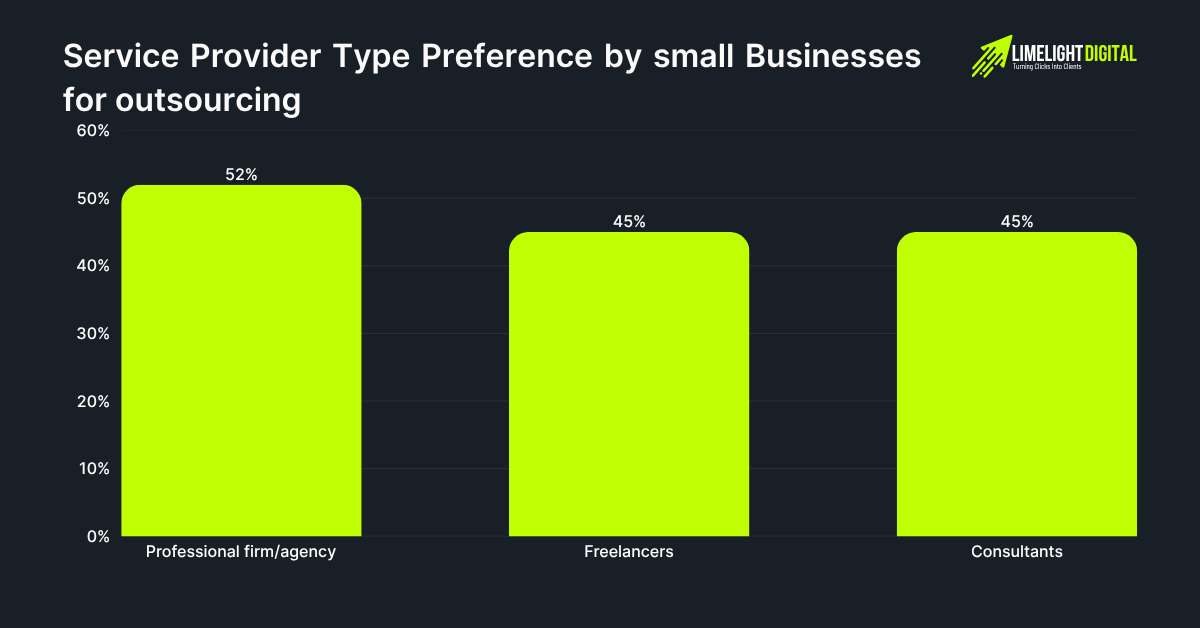
Here is a tabular view of the service provider type that is preferred by small businesses for outsourcing:
| Service Provider Type | Preference % |
|---|---|
| Professional firm/agency | 52% |
| Freelancers | 45% |
| Consultants | 45% |
Source: Microsourcing
83% of small businesses planned to keep or increase their outsourcing spending in 2023, signalling strong, sustained demand.
Source: Clutch 2
Small businesses delegate about 45% of their IT work to outsourcing vendors, 59% of SMBs have outsourced app development.
Source: Doit
In 2024, 46% of UK companies outsourced marketing functions, 50% of B2B firms, and 41% of B2C firms relied on external marketing partners.
Source: Passive Secrets
Outsourcing By Business Function
Outsourcing adoption varies by function, but IT and software development remain the most outsourced areas due to growing demand for specialized skills, cybersecurity expertise, and digital transformation support.
IT and Software Development
77% of businesses outsource their IT functions, spending an average of 8.1% of their total budget on IT outsourcing, up 1.7% from 2019.
Source: Doit
In 2024, cybersecurity and IT infrastructure services tied as the most outsourced IT functions at 77% each, application development followed at 72%.
Source: LinkedIn
93% of organizations planned to outsource parts of their workflows to cybersecurity vendors over 2024–2025, and security spending reached $90 billion in 2024, up 11% year-on-year.
Source: PR Newswire
BFSI is the leading IT outsourcing vertical, accounting for 30.29% of sector value, approximately $155 billion in 2024.
Healthcare IT outsourcing spending reached $120 billion in 2024, reflecting the rapid digitisation of clinical and administrative workflows.
Source: Doit
The UK outsourced IT services market reached $24.56 billion in 2024 and is expected to hit $52.03 billion by 2033 at a CAGR 8.70%, 80% of UK businesses struggle to recruit technology professionals.
Source: IMARC
Customer Service Outsourcing
38% of businesses globally outsource customer service, making it the most outsourced front-office function.
Source: MyOutDesk
The global outsourced customer experience market was worth $82.23 billion in 2024, projected to reach $205.1 billion by 2032 at 11.1% CAGR.
Source: Fortunly
90% of customers say an ‘immediate’ response is important when contacting customer service, a key driver pushing firms towards outsourced support operations.
Source: Hubspot
Outsourcing in Marketing
50% of executives now outsource front-office capabilities, including sales, marketing, and R&D.
Source: Deloitte
Over 50% of US companies outsource digital marketing, content strategy, SEO, and social media management.
Source: Virtual Latinos
46% of UK companies outsourced marketing in 2024, with B2B adoption (50%) outpacing B2C (41%).
Source: Passive Secrets
Outsourcing in Accounting And Finance
61% of companies opt for outsourcing financial tasks, including accounting and bookkeeping.
Source: Passive Secrets
Approximately 40% of US businesses outsource financial processes, including bookkeeping, tax, audits, and forecasting, a trend especially prevalent among SMEs.
Source: Virtual Latinos
60% of US companies are expected to outsource finance and accounting functions by 2027, and the payroll outsourcing market is expected to grow at 4.79% annually through 2028.
Source: GlobalTeam
Geographical Outsourcing Insights
The US generates 37.6% of the total outsourcing industry revenue and accounts for 38.4% of the global BPO market revenue in 2025.
Source: Doit
55.6% of the top 500 global outsourcing firms are headquartered in the United States, followed by India at 12.6%.
Source: Knowledge Sourcing
Asia Pacific dominates IT outsourcing with 36% revenue share in 2024 and the fastest projected growth at 8.34% CAGR through 2030. India and the Philippines remain the primary offshore destinations.
Source: Precedence Research
Emerging markets like Vietnam and Colombia offer 20% average cost reduction compared to established outsourcing markets.
Source: MyOutDesk
The UK accounts for 5.8% of the global outsourcing services market in 2024, the second-largest economy in Europe, and among the top outsourcing spenders globally.
Source: Grand View Research
Revenues in the UK’s IT outsourcing market are projected to reach €38.9 billion by 2025, growing at 7.18% annually to €55.1 billion by 2030. The UK ranks among the top European ITO markets.
Source: CBI EU
Challenges In Outsourcing
Approximately 30% of outsourcing relationships fail within the first year, typically due to communication barriers, cultural differences, and misaligned expectations.
Source: CSV
Cybercrime is anticipated to cost the world $10.5 trillion a year by 2025, adding to the pressure on BPOs that handle sensitive financial, medical, and customer data.
Source: Cyber Security Ventures
Nearly 70% of the organisations surveyed find their Vendor Management Office (VMO) still immature, which is a significant governance gap in managing outsourcing relationships.
Source: Deloitte
76% of UK companies struggle to fill different job roles, intensifying reliance on outsourced providers but also raising quality-control risks.
Source: British Chambers
Outsourcing Trends 2026
92% of organisations expect their outsourcing vendors to integrate AI capabilities into service delivery, a near-universal expectation as of Deloitte’s 2024 survey.
Source: Deloitte
The global BPO market is valued at $328.37 billion in 2025, estimated to reach 695.77 billion by 2033 with a 9.9% CAGR.
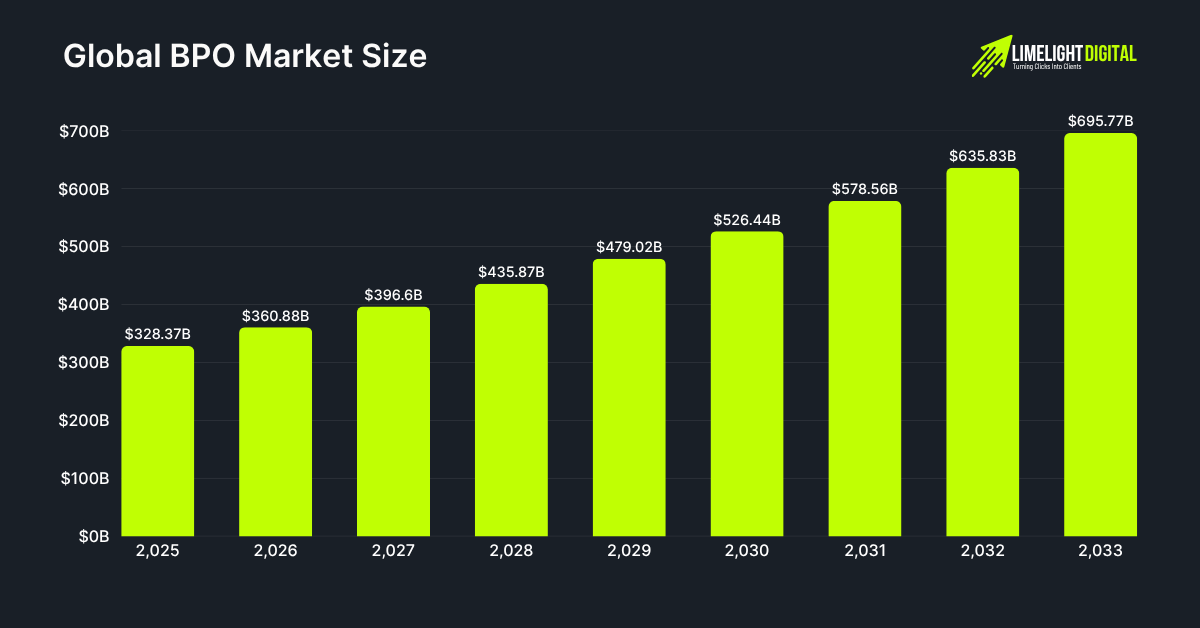
Below is the projected growth of the global BPO market:
| Year | Market Size |
|---|---|
| 2025 | $328.37 billion |
| 2026 | $360.88 billion* |
| 2027 | $396.60 billion* |
| 2028 | $435.87 billion* |
| 2029 | $479.02 billion* |
| 2030 | $526.44 billion* |
| 2031 | $578.56 billion* |
| 2032 | $635.83 billion* |
| 2033 | $695.77 billion* |
*Estimated Figures
Source: Grand View Research
AI-driven tools deployed in the outsourcing domain have resulted in operational cost savings of 15-30%, higher first-contact resolution rates, and improved customer experience, according to providers.
According to Gartner, by 2028, 70% of customers will initiate their interactions with a brand using conversational AI interfaces, driving accelerated adoption of ingredient AI-powered customer journeys.
Source: Outsource to Vietnam
Global Capability Centres (GCCs) are accelerating as a complementary strategy, 20% of organisations already have a digital workforce strategy for AI and automation bots.
Source: Deloitte