
Augmented Reality has become an integral component of the digital front across sectors, including retail, healthcare, education, and entertainment. According to reports, the global market for augmented reality will hit $298.45 billion by 2032, fuelled by the rising need for immersive experiences, mobile augmented reality, and enterprise augmented reality.
The following piece highlights the top statistics and facts about the future of augmented reality in 2026.
Key Augmented Reality Statistics
- Global AR market projected to reach $298.45 billion by 2032.
- The AR retail market is expected to grow from $6.87 billion to $67.73 billion.
- North America held over 34% of the AR revenue share.
- AR increases e-commerce conversion rates by up to 94%.
- AR and VR to create 23 million jobs worldwide.
AR Market Size & Growth Statistics
The global augmented reality market was valued at approximately $57.04 billion in 2024 and is projected to reach $298.45 billion by 2032, representing a CAGR of 25.35% from 2026 to 2032.
Source: Verified Market Research
A separate analysis by Grand View Research places the market at $120.21 billion in 2025, climbing to $1,050.56 billion by 2033 at a CAGR of 29.7%, underscoring how rapidly consensus estimates are being revised upwards.
Source: Grand View Research
SkyQuest values the AR market at $58.29 billion in 2024, forecasting growth to $828.47 billion by 2033 at a CAGR of 34.3%.
Source: SkyQuest
The table below shows different projections of the global AR market:
| Research Firm | Base Year | Market Size (Base Year) | Forecast Year | Projected Market Size | CAGR | Forecast Period |
|---|---|---|---|---|---|---|
| Verified Market Research | 2024 | $57.04 billion | 2032 | $298.45 billion | 25.35% | 2026–2032 |
| Grand View Research | 2025 | $120.21 billion | 2033 | $1,050.56 billion | 29.7% | 2026–2033 |
| SkyQuest Technology | 2024 | $58.29 billion | 2033 | $828.47 billion | 34.3% | 2026–2033 |
AR software alone commanded the largest market volume at $13.0 billion in 2024, while hardware led with a 59% revenue share in 2025 as enterprise headset investment surged.
Source: Statista
North America held more than 34% of global AR revenue in 2025, with Asia-Pacific expected to register the fastest growth at a CAGR exceeding 33% through 2033.
Source: Grand View Research
The AR & VR industry is forecast to contribute up to £1.4 trillion to the global economy by 2030 and create 23 million new jobs worldwide.
Source: PWC
In 2025, the augmented reality market in the UK generated a revenue of $9,061.1 million and is predicted to reach $76,024 million by 2033, growing with a CAGR of 29.1%. In 2025, the AR market in the UK made up 7.5% of the whole world and is growing as the fastest AR market in Europe.
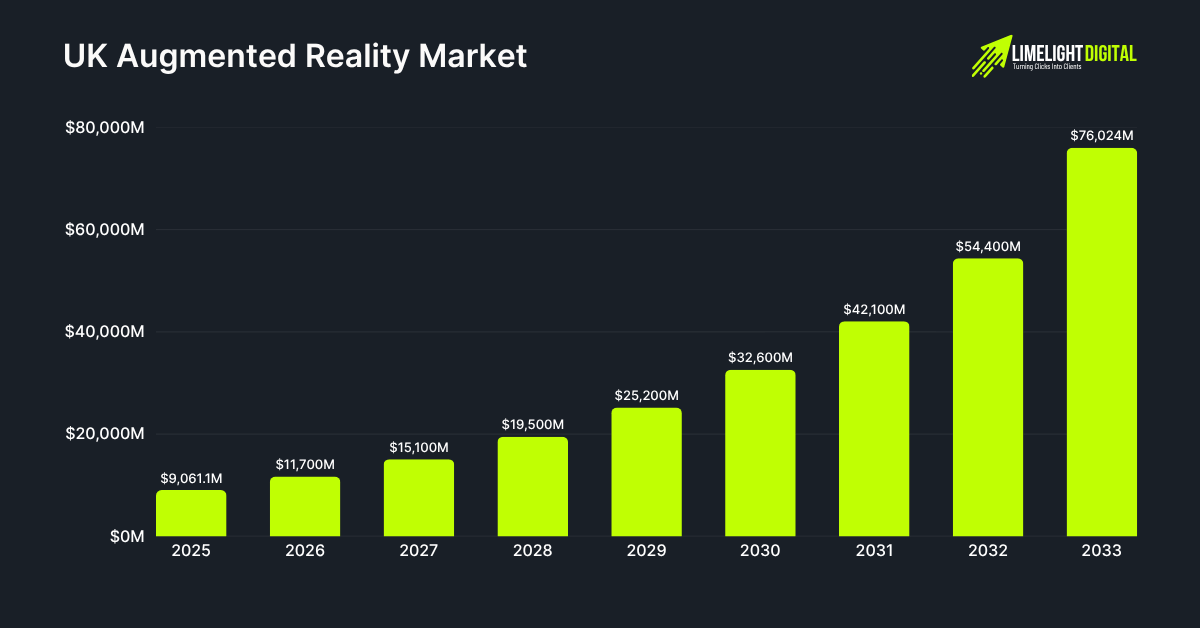
The table below estimates the growth of the UK augmented reality market:
| Year | Revenue |
|---|---|
| 2025 | $9,061.1 million |
| 2026 | $11,700 million* |
| 2027 | $15,100 million* |
| 2028 | $19,500 million* |
| 2029 | $25,200 million* |
| 2030 | $32,600 million* |
| 2031 | $42,100 million* |
| 2032 | $54,400 million* |
| 2033 | $76,024.0 million |
*Estimated Values
Source: Grand View Research 2
The UK mobile AR market was estimated at $549.15 million in 2024 and is projected to surge to $29,335.5 million by 2035, a remarkable CAGR of 43.5%, driven by retail and gaming applications.
Source: Market Research Future
Augmented Reality User Demographics & Adoption Trends
There were an estimated 1.02 billion mobile AR users worldwide in 2024, encompassing monthly active users of AR apps, WebAR experiences, and visual search tools. This is projected to rise to 1.1 billion by 2028.
YouTube users have grown to 2.70 billion worldwide, reinforcing the scale of video-first platforms competing with AR content.
Source: Statista
And by the end of 2025, it was estimated that more than 2 billion people worldwide would be using mobile AR, up from 1.7 billion active AR-enabled devices in 2024 (also a bump over those who had access to such devices, around 1.1 billion in 2022).
Source: ElectroIQ
Consumer AR awareness is strongly age-stratified: 70%-75% of people aged 16-44 are aware of AR, versus 56% among those aged 45-54 and just 44% of those aged 55-64.
Source: ElectroIQ
In the United States, AR users reached 95.5 million in 2024 and were projected to grow to 100.1 million in 2025, 103.9 million in 2026, and 106.9 million in 2027.
| Year | AR Users |
|---|---|
| 2024 | 95.5 million |
| 2025 | 100.1 million* |
| 2026 | 103.9 million* |
| 2027 | 106.9 million* |
Source: Meetanshi
Over 300 million Snapchat users engage with AR features every single day, more than two-thirds of Snapchat’s daily active user base, with over 70% of new Snapchatters using AR on their first day on the app.
Source: Snapchat 1, Snapchat 2
Over 54% of TikTok users engage daily, showing strong demand for interactive and AR-enhanced content experiences.
The global AR/VR user base is expected to reach 3.7 billion by 2029, while deskless workers, who make up around 80% of the global workforce, are expected to be a key driver of enterprise AR adoption.
Source: G2
72% of luxury fashion shoppers in the UK want to use AR in their digital experiences, according to a survey by Vogue Business and Snap Inc., signalling premium consumer willingness ahead of mainstream retail deployment.
Source: Scribd
How AR Is Transforming Marketing & Retail
The global augmented reality in retail market was valued at $6.87 billion in 2024 and is projected to grow to $67.73 billion by 2032, at a CAGR of 33.19%. Virtual try-on is the fastest-growing application segment, at over 36% CAGR through 2033.
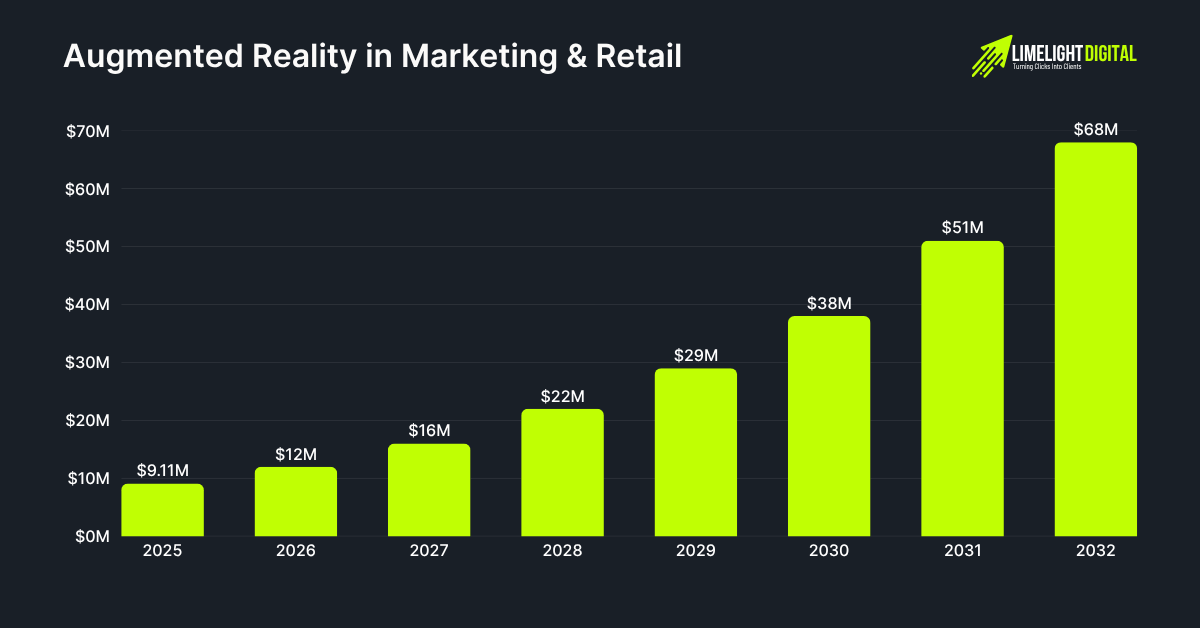
Take a look at the estimated growth of the global augmented reality in the retail market:
| Year | Market Size |
|---|---|
| 2025 | $9.11 billion |
| 2026 | $12.13 billion* |
| 2027 | $16.15 billion* |
| 2028 | $21.51 billion* |
| 2029 | $28.67 billion* |
| 2030 | $38.20 billion* |
| 2031 | $50.94 billion* |
| 2032 | $67.73 billion |
*Estimated Values
Source: Kings Research
Retail alone takes 55% of all AR usage next year, the biggest application category by far, ahead of gaming, manufacturing, and healthcare.
Source: Threekit
AR advertising revenue is predicted to reach $6.72 million by 2027, with brands reallocating marketing budgets away from passive display advertising and towards first-person interactive AR-based campaigns.
Source: Amra & Elma
Instagram reels generate 2x more impressions than other content formats, highlighting how AR-driven short videos boost engagement.
Over 150 major retail chains around the world have already introduced AR technologies to their online or in-store experiences, and global retail AR users are projected to reach 1.3 billion people, a jump of 22% from 2022.
Source: 360 Research Reports
Approximately 40% of consumers say they would spend more on a product if they could first try it through AR, and 71% state they would shop more frequently if AR were available.
Source: ElectroIQ
Over 65% of beauty and fashion retailers have introduced AR try-on experiences via mobile apps or smart mirrors. The integration of AR mirrors in fashion stores increased by 26% in 2023, lifting average customer engagement time by 18 minutes per session.
Source: 360 Research Reports
More than 250 million Snapchatters have engaged with AR shopping lenses more than 5 billion times, illustrating how social commerce and AR are converging into a powerful retail channel.
Source: G2
The UK mobile AR retail application segment is projected to be valued at $29,335.5 million by 2035, while the healthcare AR segment in the UK was already valued at $788.41 million in 2025, reflecting diversified AR demand across UK verticals.
Source: Market Research Future
Augmented Reality Engagement & Conversion Statistics
Implementing AR in online stores can lead to a 94% higher conversion rate compared to standard product listings, making it one of the highest-ROI digital tools available to e-commerce operators.
Source: Amra & Elma
Retailers implementing AR virtual try-on solutions report an average 30% increase in sales conversion rates and a corresponding 30% reduction in product returns.
Source: Onix Systems
Brands using AR have recorded up to a 40% reduction in product return rates, a critical metric as returns represent one of the largest cost centres in e-commerce logistics.
Source: Yahoo Finance
U.S. retailers report a 20% rise in conversion rates when using AR tools, with 58% of millennial consumers expressing a preference for stores that offer AR features.
Source: LinkedIn, Morning Star
72% of online shoppers said they were more likely to purchase a product after experiencing it through AR visualisation, while 65% of customers reported increased satisfaction when using AR-enhanced shopping tools.
Source: 360 Research Reports
73% of mobile AR users report high satisfaction with their AR experiences, a figure that underscores the technology’s maturity and the positive user sentiment it generates.
Source: Threekit
79% of consumers globally say they are interested in using AR to interact with a product before buying, and 61% indicate they would be more likely to purchase from a brand that implements immersive technologies.
Augmented Reality Hardware, Devices & Smart Glasses Market
The consumer and enterprise AR glasses and headset market was valued at $6.3 billion in 2024, with projections suggesting it could rise to over $8.5 billion in 2025, a potential increase of more than 34.92% in a single year.
Source: Statista
Global AR/VR headset shipments reached 9.6 million units in full-year 2024, growing 8.8%-10% year-over-year. IDC forecasts combined AR/VR + display-less smart glasses shipments to grow 39.2% in 2025, reaching 14.3 million units, largely driven by smart glasses growing 247.5%.
Source: IDC
Meta held approximately 60.6% of the combined AR/VR + smart glasses market in Q2 2025, with Xiaomi at 7.7%, XREAL at 4.1%, and RayNeo at 2.7%, indicating a market that is diversifying but still dominated by a single player.
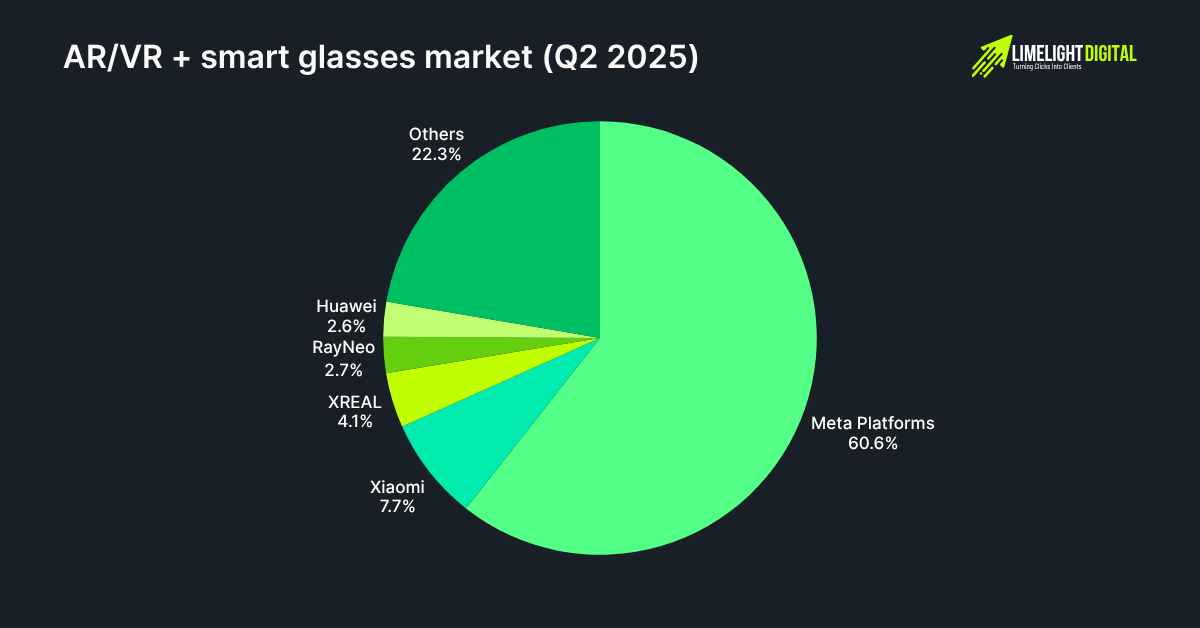
Below is the tabular view of the market shares of different AR/VR + smart glasses companies:
| Rank | Company | Market Share (Q2, 2025) |
|---|---|---|
| 1 | Meta Platforms | 60.6% |
| 2 | Xiaomi | 7.7% |
| 3 | XREAL | 4.1% |
| 4 | RayNeo | 2.7% |
| 5 | Huawei | 2.6% |
| 6 | Others | 22.30% |
Source: IDC
The French-Italian eyewear brand added that it sold more than 7 million AI glasses in the last year alone, and Ray-Ban Meta smart glasses accounted for more than 2 million units after their October 2023 debut, while sales tripled in Q2 2025, marking that fashionable yet technology-enabled wearables strongly appeal to mainstream consumers.
Source: CNBC
ABI Research forecasts AR hardware shipments to grow at a CAGR of 62.2% from 2024 to 2030, increasing from 2.8 million units in 2024 to 51.7 million units in 2030. The global installed base for AR smart glasses will reach 132.7 million users by 2030.
Source: ABI Research
IDC forecasts the AR/VR hardware market to reach 43.1 million units by 2029, growing at a CAGR of 31.8%, with spending on apps, services, and related technologies expected to increase 19.7% in 2025 to nearly $12 billion worldwide.
| Quarter | Others | ByteDance | Meta | RayNeo | Viture | XREAL |
|---|---|---|---|---|---|---|
| 2024Q2 | 339,601 | 59,769 | 696,067 | 30,897 | 20,531 | 48,555 |
| 2024Q3 | 308,776 | 89,096 | 1,178,127 | 31,659 | 30,978 | 56,449 |
| 2024Q4 | 294,479 | 100,524 | 3,503,948 | 36,970 | 48,811 | 90,631 |
| 2025Q1 | 114,288 | 62,982 | 333,195 | 39,615 | 40,918 | 79,624 |
| 2025Q2 | 122,155 | 52,738 | 549,014 | 68,809 | 40,326 | 103,774 |
Source: IDC
In October 2024, the UK Ministry of Defence initiated trials of AI-powered AR smart eyewear (XRAI Glass) to assist employees with hearing impairments, overlaying real-time speech transcription, demonstrating public-sector AR hardware adoption in the UK.
Source: Market Research Future
Hardware accounted for 83.23% of the UK AR market revenue in 2025, with the UK AR software segment expected to register the fastest growth through 2033, as enterprise deployments move from device procurement to managed services and content platforms.
Source: Grand View Research
Real-World Applications of AR Across Industries
The global AR & VR in healthcare market was valued at $3.82 billion in 2024 and is expected to reach $47.58 billion by 2033 at a CAGR of 32.33%, the fastest-growing AR application segment in Grand View Research’s analysis.
Source: Market Data Forecast
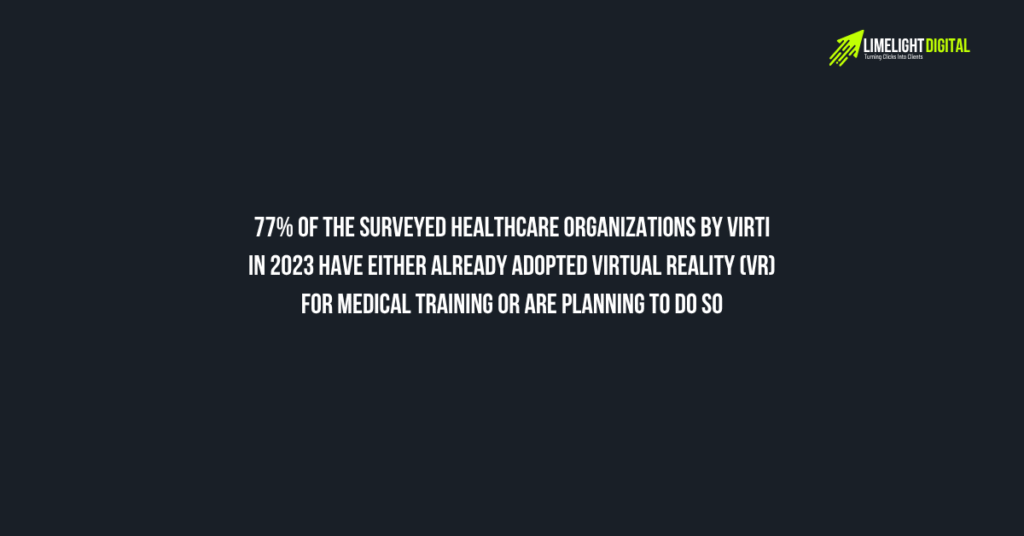
A survey by Virti found that about 77% of healthcare organizations have either already adopted virtual reality (VR) for medical training or are planning to do so.3
Source: Telemedicine
Medical training and education represented the largest sub-segment at 29.5% of the 2024 AR/VR in healthcare market, as institutions adopt immersive simulation to reduce surgical risk and improve trainee confidence.
Source: Precedence
AR inspection tools reduce error rates by 25% in quality control processes, while warehouse operations using AR overlays show up to 20% improvement in picking accuracy. Heavy-equipment training with AR reduces incident rates by over 40%.
75% of large industrial companies implementing AR and VR report at least a 10% improvement in operational efficiency. In 2024, approximately
Source: Cape Gemini
The global AR & VR in education market was estimated at $2.9 billion in 2022 and is projected to reach $14.2 billion by 2028, expanding at a CAGR of 29.6%
Source: Markets & Markets
30% of universities worldwide now offer VR-based courses as of 2024, with Meta’s education segment push driving 69.4% growth in educational VR deployments during the year.
Source: Treeview Studio
The global AR gaming market was valued at $17.9 billion in 2025 and is forecast to reach $147 billion by 2034 at a CAGR of 25.60%.
Source: IMARC
VR/AR adoption in UK schools rose 35% in 2024, with 93% of teachers reporting enhanced student engagement, aligning with the University of Birmingham’s RESILIENCE Centre deployment of mixed-reality pharmaceutical manufacturing scenarios.
Source: GoStudent
In April 2025, Cardiff Youth Service piloted a mobile AR app to help teenagers experiencing anxiety, with early findings indicating improvements in social connection and reductions in anxiety levels, a pioneering UK public-health AR deployment.
Source: BBC