In fact, 99% of Fortune 500 Companies also use Artificial Intelligence in recruitment, and it is redefining how companies source, evaluate, and hire talent. AI tools are also aiding employers in automating repetitive tasks and driving hiring efficiency, from resume screening to predictive candidate matching.
In this article, we examine key statistics on AI adoption and use in recruitment, as well as market growth trends and forecasts for the future of AI.
Top AI Recruitment Statistics
- 87% of companies are now incorporating AI into their recruitment processes.
- 99% of Fortune 500 firms have integrated AI in hiring.
- 8 out of the top 10 Fortune companies are using Claude.
- In 2025, 39% of organizations used AI for HR and recruitment activities.
- 88% of companies use some form of AI recruiting software.
- AI can reduce the time to hire for organizations by up to 25%.
- 98% of hiring managers report improved efficiency with AI.
- Global AI recruitment market projected to reach $1.125 billion by 2033.
AI In Recruitment And AI Recruitment Adoption
As of early 2026, 87% of companies are now using AI in recruitment, and a surprising 99% of Fortune 500 firms have integrated it into their processes. Along with this, 8 out of the top 10 Fortune companies are Claude customers. This indicates near-universal adoption among leading corporations.
In 2025, 43% of organizations globally utilized AI for HR and recruiting tasks, marking a significant increase from 26% in 2024. This indicates a rapid acceleration in AI adoption within human resources.
Source: SHRM
As of early 2025, 99% of hiring managers reported integrating AI into their hiring processes in some capacity. This widespread usage highlights AI’s pervasive presence in modern recruitment.
Source: Insights Global
In fact, approximately 88% of companies are already using some form of AI recruiting software. This points to a strong inclination towards making AI-based solutions the norm within hiring.
Source: World Economic Forum
An impressive 73% of talent acquisition (TA) professionals in organizations expect that AI will transform the hiring processes in said establishments. This underscores a wide awareness of AI’s world-changing possibilities.
In fact, 37% of TA pros were either actively integrating or experimenting with GAI tools in 2025, up from 27% in 2024. An increase is a welcome sign of more interest and practical implementation with advanced AI in recruiting.
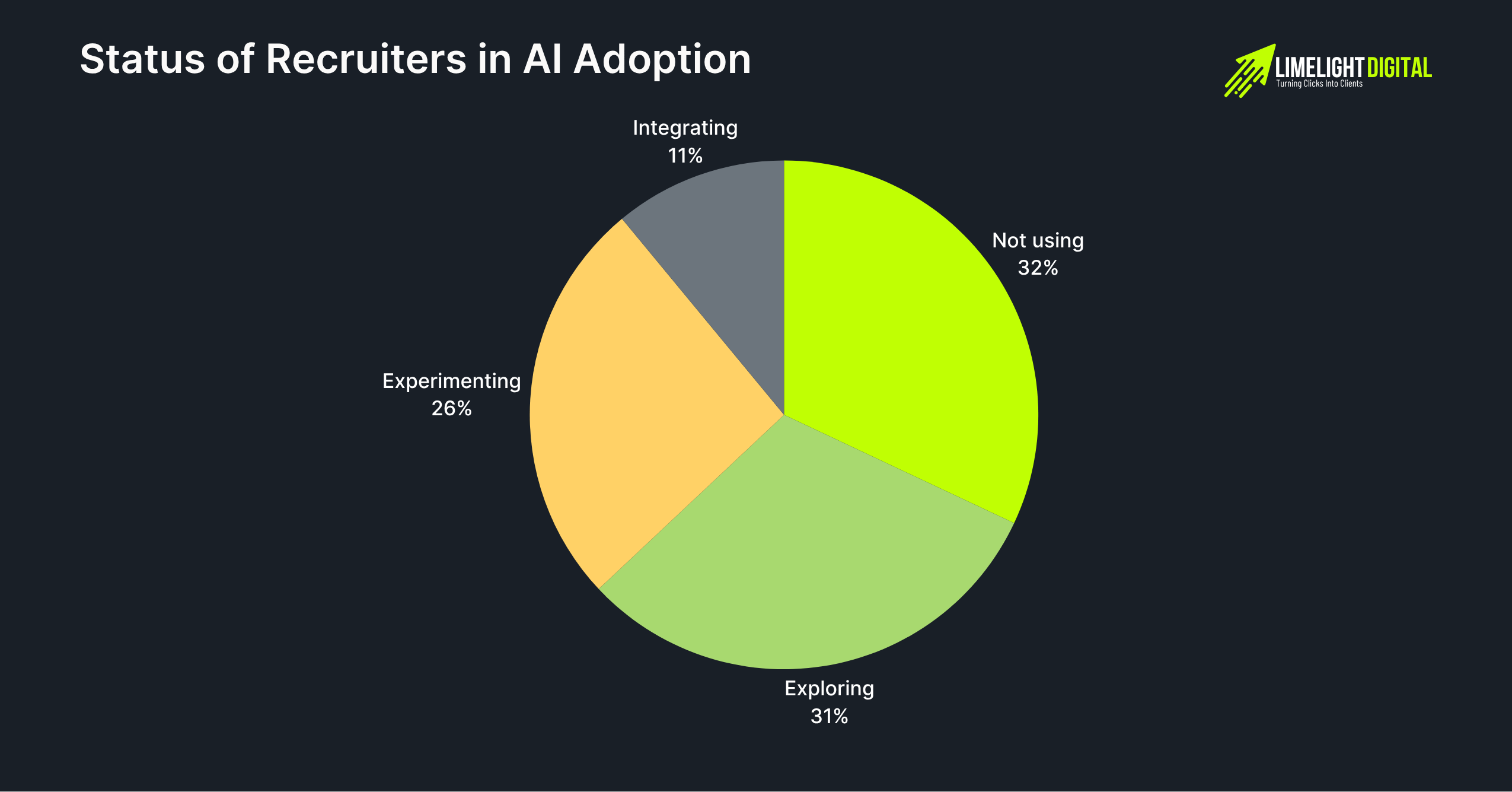
You can find the details of the status of recruiters in the adoption of AI in recruitment activities in the table below:
| Status | Percentage of Recruiters |
|---|---|
| Not using | 32% |
| Exploring | 31% |
| Experimenting | 26% |
| Integrating | 11% |
Source: LinkedIn
By 2026, up to one in three companies will have their whole hiring process managed by AI. This forecast is a bit prescient, a world where AI becomes the focal point of recruitment operations.
Source: Resume
AI In Talent Acquisition And AI In Hiring
So recruiting is by far the HR practice area where AI is most deployed, with 51% of organizations using AI for recruitment. That highlights AI’s most significant domain attraction and selection of talent.
AI is widely used by HR professionals for specific tasks, with 66% leveraging it for writing job descriptions. This indicates AI’s role in automating and enhancing the initial stages of the hiring process.
Resume screening is another common application, with 44% of HR professionals using AI for this purpose. This high adoption is partly at the root of AI’s, speeding through huge swathes of applications.
For automating candidate searches, 32% of HR professionals rely on AI. This highlights AI’s capability to streamline the identification of potential candidates.
Source: SHRM
A significant 74% of hiring managers believe AI can effectively assess the compatibility of an applicant’s skills with job requirements. This suggests confidence in AI’s analytical capabilities for skill matching.
A huge majority of 74% hiring managers believe AI can efficiently assess the compatibility of an applicant’s skills with respect to the job requirements. This suggests confidence in AI’s analytical capabilities for skill-based matching.
Source: Insights Global
The adoption of AI in talent acquisition (TA) and hiring is increasing, yet organizations are doing so cautiously. Despite almost half of organizations (49%) saying they have used AI even to a small extent, only 14% are utilizing it extensively in TA, and 37% do not use AI at all.
This means interest and experimentation are high, but widespread fully-taped integration is low.
The most common applications where organizations are using AI are practical and task-oriented. Using AI to assist with writing job descriptions is used by 65% organizations, whereas generating or improving interview questions is done through AI by another 67%.
Streamlining communication with candidates (43%) and resume filtering are also some of the common tasks where AI is being used.
These use cases suggest that companies are primarily turning to AI to improve efficiency and standardize repetitive aspects of the hiring process.

Despite these benefits, concerns remain significant. The top issue cited is the risk of bias (58%), followed by fears of depersonalization in candidate interactions (51%) and potential liability for unintentional discrimination (50%).
These concerns help explain why many organizations are moving forward carefully rather than fully automating hiring workflows.
Even with these reservations, the most widely recognized benefit of AI in talent acquisition is time savings, with 70% of organizations identifying efficiency gains as a key advantage.
As a result, AI in hiring is evolving as a tool to augment human decision-making, improving speed and consistency, while organizations continue to balance innovation with fairness, compliance, and candidate experience.
Source: Eightfold
By 2026, 40% of enterprise applications are expected to include task-specific AI agents, marking a significant shift from 2025. This indicates a growing trend towards specialized AI integration within talent acquisition systems.
Source: Master Of Code
AI Recruitment Companies And Companies Using AI For Recruitment
Publicly traded for-profit organizations are at the forefront of AI adoption in HR, with 58% utilizing AI, surpassing private for-profits (45%) and nonprofits (38%). This suggests greater exposure to AI investment in public companies.
Source: SHRM
Applicant Tracking Systems (ATS) remain the primary recruitment technology, used by 78% of organizations. This shows the foundational role of ATS, often integrated with AI functionalities.
67% of organizations use employment hiring platforms. These platforms frequently incorporate AI to enhance various stages of recruitment.
Source: Eightfold
For Instance, Brother International Corporation increased completed applications by 140% by deploying an AI-powered Talent CRM that improved candidate engagement.
Thermo Fisher Scientific uses AI-powered talent tools that fill 40% of its roles internally, emphasizing how effectively AI can drive internal mobility and utilization of current associates.
Source: Phenom
Leading companies such as Uber, Siemens, and Eli Lilly are recognized for their advanced integration of AI to improve the quality of hire and implement skills-based hiring strategies. Their examples illustrate successful AI implementation in large enterprises.
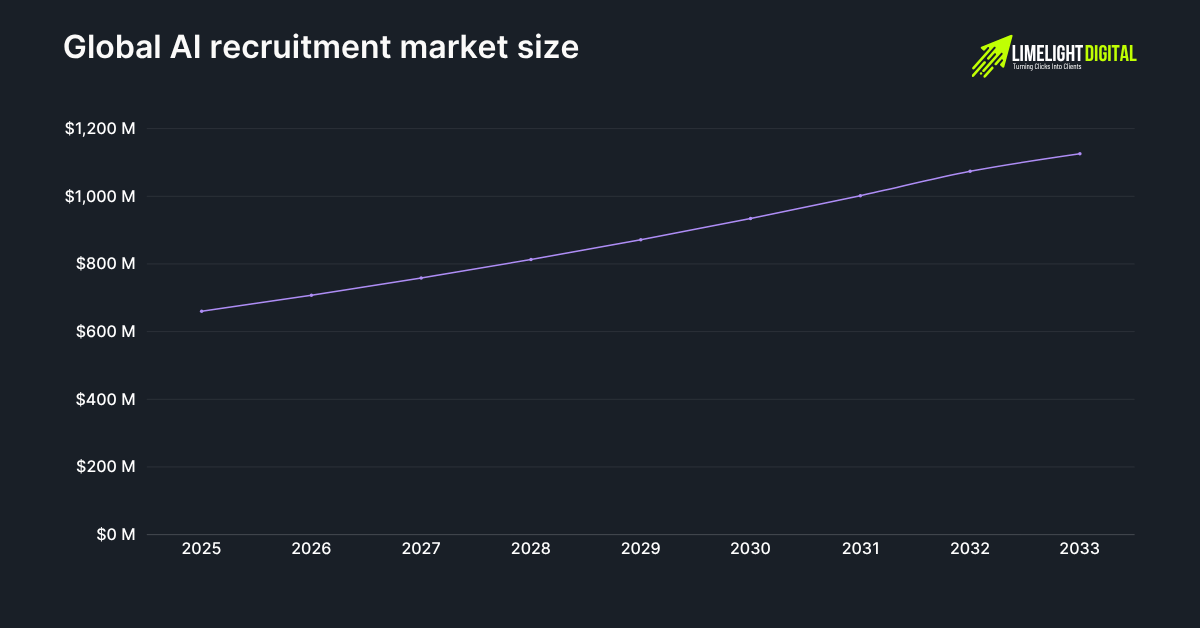
The global AI recruitment market was valued at $617.56 million in 2024. It is projected to increase to $660.17 million in 2025 and further expand to approximately $1,125.84 million by 2033, registering a CAGR of 7.2% over the forecast period from 2025 to 2033.
| Year | Estimated Market Size |
|---|---|
| 2025 | $660.17 million |
| 2026 | $707.70 million |
| 2027 | $758.64 million |
| 2028 | $813.26 million |
| 2029 | $871.81 million |
| 2030 | $934.59 million |
| 2031 | $1,001.88 million |
| 2032 | $1,073.98 million |
| 2033 | $1,125.84 million |
Source: Straits Research
The rapid growth of AI in recruitment has led to the rise of specialized AI-driven hiring platforms, while many global enterprises are actively integrating these technologies into their talent acquisition strategies.
Many of the technologies powering modern hiring tools are being developed by innovative AI Startups In London, and you can explore some of the most promising companies in our detailed guide to the Top 50 AI startups shaping the UK AI ecosystem in 2026.
AI Recruitment Companies (Platforms & Agencies):
- Phenom, Paradox (Olivia), hireEZ (Hiretual), SmartRecruiters, Workable, HireVue, Andela, Job3s, Folks HR, PasaJob, Mercor, etc.
Companies Using AI in Hiring:
- Unilever, IBM, Intel, Johnson & Johnson, Simplilearn, Welspun, Hilton, and many larger enterprises are integrating AI tools into recruiting processes.
AI Recruitment Performance Metrics
A substantial 98% of hiring managers reported significant improvements in hiring efficiency through the use of AI. This statistic emphasizes AI’s effectiveness in optimizing recruitment workflows.
Source: Insights Global
AI is recognized by 89% of HR professionals for its ability to save time or increase efficiency. This highlights the operational benefits derived from AI integration.
Source: SHRM
Recruiters who utilize AI-assisted messaging are 9% more likely to achieve a quality hire. This suggests a direct correlation between AI tool usage and improved hiring outcomes.
Source: LinkedIn
Organizations employing AI in hiring have observed up to a 25% reduction in their time-to-hire. This illustrates AI’s role in accelerating the recruitment cycle.
Source: Ultimate Recruitment
70% of TA professionals point to time savings as the top downside-reducing aspect of AI. This plays into the framing of AI as a mechanism for operational efficiency.
Source: Eightfold
Approximately 33% of TA professionals expect AI to contribute to an increase in the quality of hires. This indicates a forward-looking perspective on AI’s potential to enhance talent acquisition.
Source: LinkedIn
Revenue per worker in industries with more exposure to AI has risen threefold since 2022. The data, therefore, indicates a positive relationship between AI adoption and productivity gains.
Workers with such skills demand a 56% higher wage on average, up from just 25% in 2024. This also reflects the increasing demand for AI-related skills in the labor market.
Source: PWC
Future Of AI In Recruitment
As per SHRM, 7% of the surveyed organizations are planning to implement AI in HR functions.
Source: SHRM
A large majority, 95%, of US hiring managers foresee increased investment in AI to further optimize recruitment processes. This indicates a strong commitment to future AI integration.
Source: Insights Global
Over the next two years, 53% of organizations anticipate an increase in their use of AI in recruitment. This projection suggests continued expansion of AI’s role in talent acquisition.
Source: Eightfold
Prioritizing candidate experience in their TA technology strategy over the next two years. This indicates a focus on human-centric AI applications.
By mid-2026, 80% of high-volume recruiting is expected to commence with an AI-powered voice screen. This highlights the increasing automation of initial candidate interactions.
Source: Disher Talent
The demand for recruiters possessing “relationship development” skills has surged 54 times on LinkedIn, as AI increasingly handles routine tasks. This suggests a shift towards higher-value, interpersonal skills for human recruiters.
Source: LinkedIn
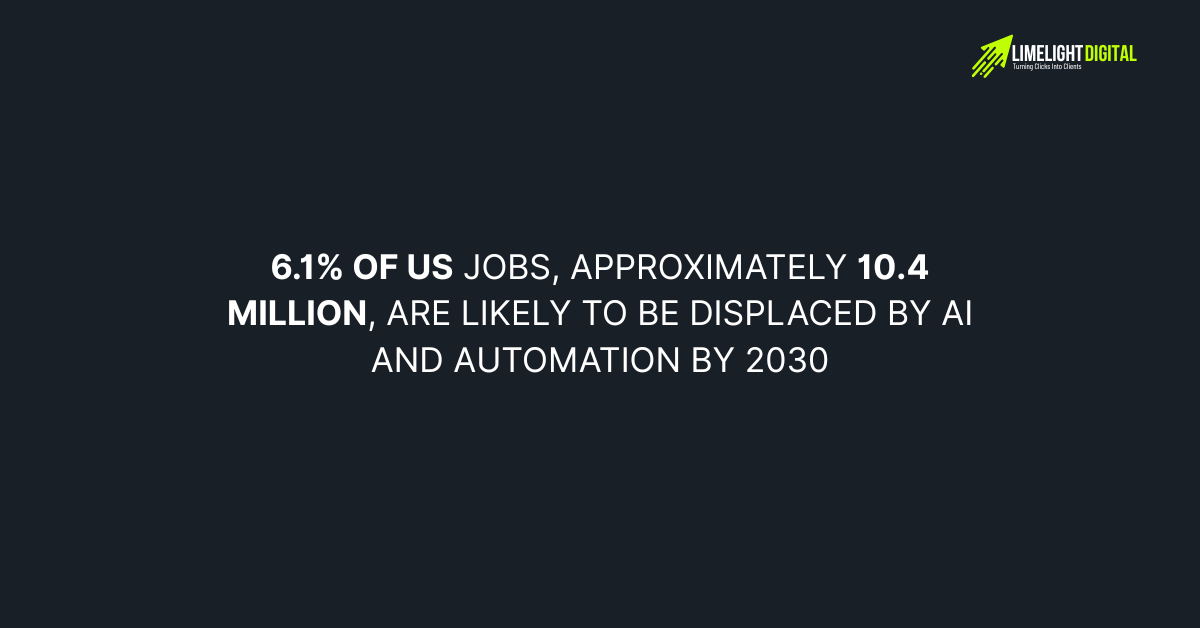
It is predicted that 6.1% of US jobs, approximately 10.4 million, will be displaced by AI and automation by 2030. This forecast underscores the potential for significant workforce transformation due to AI.
Source: Forrester
Skills needed for AI-exposed jobs are changing 66% faster than those for other jobs, a 2.5x acceleration vs. 2024. This exemplifies the largely breakneck rate of skill evolution facilitated by AI.
In the most exposed industries, wages are growing twice as fast as in the least exposed. This reveals a widening economic gap for those sectors adopting AI technologies.
Source: PWC