With 46% of Google searches showing local intent, billions of daily queries are seeking nearby products and services, making local SEO crucial for any business.
In this article, we will look at key local SEO trends, consumer behaviour, essential tools, and actionable strategies to enhance visibility, build trust, and grow local business revenue.
Local SEO Statistics 2026: Top Picks
- 46% of Google searches have local intent, showing billions of daily queries seek nearby services.
- “Near me” searches have grown 500%–900%, reflecting huge local search interest.
- 76%–88% of local searches lead to a physical visit within 24 hours, driving immediate action.
- A complete Google Business Profile increases trust 2.7× and boosts customer visits by 70%.
- 78% of local mobile searches result in offline purchases, highlighting mobile search-to-store conversion.
- Average ROI for local SEO exceeds 500%, making it one of the most profitable marketing strategies.
Local SEO and Business Visibility
Currently, 46% of Google searches contain local intent. This means billions of daily queries are specifically seeking nearby physical services.
Between 97% to 99% of people utilize the internet to find local businesses. Online discovery is the universal starting point.
Local Search Behaviour and Consumer Intent
The following metrics illustrate the frequency of local search and the rapidly increasing intent behind modern consumer queries.
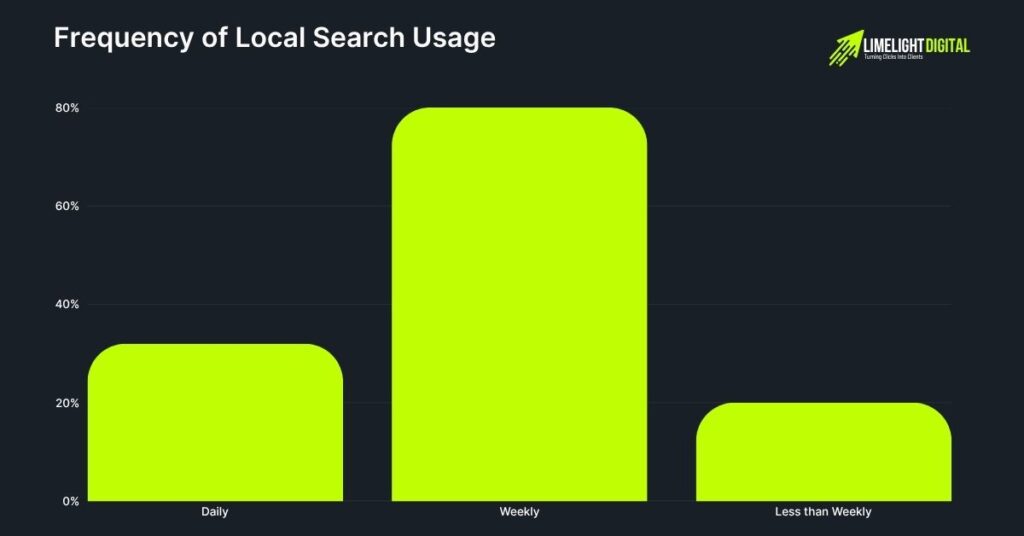
- About 32% of people perform local searches every day, showing that local search is part of daily online behavior.
- Around 80% of people use local search at least once a week, highlighting its importance for businesses to stay visible.
- Approximately 61% of consumers rely on business information sites when looking for new businesses, showing the value of maintaining accurate listings.
- “Near me” searches have grown by 500%–900%, indicating a huge increase in users searching for nearby products or services.
Source: Backlinko, Ranktracker, BrightLocal
Actions Taken After Local Searches
Local searches trigger rapid real-world actions. Between 76% and 88% of consumers go to a physical place within 24 hours of searching.
These high-intent queries lead directly to sales. Approximately 28% of local searches result in a purchase shortly after the search.
Shoppers often decide before arriving. Roughly 66% of consumers make their final purchase decision based on information found entirely online.
Source: BrightLocal, Backlinko, Think with Google
Google Business Profile (GBP) Engagement and Performance
A complete Google Business Profile (GBP) enhances perceived reputation, making businesses 2.7× more likely to be trusted.
Additionally, completing GBP boosts visibility, resulting in 70% more customer visits and increased engagement with products or services offered.
Source: Semrush
User Actions From Google Business Profiles
Google Business Profiles drive meaningful user actions, influencing both online engagement and offline visits:
- Direct Engagement: Nearly half of users jump straight into action, most clicking directly on a business profile to begin their journey.
- Map Pack Dominance: The “Local 3-Pack” is where the eyes go first; it successfully captures 42% of all search clicks from motivated buyers.
- Trust and Verification: Researching is second nature now, as 83% of people head straight to Google reviews to see if a business is actually trustworthy.
Source: BrightLocal, Backlinko
Local SEO Conversion Rates and ROI
Local searches have a significant impact on client purchases and store visits:
- About 28% of local searches result in a purchase, indicating that consumers act after searching.
- 78% of local mobile searches result in offline purchases, demonstrating how phones drive actual buying.
- Stores within 5 miles receive 72% of visits from local searchers, demonstrating that proximity is important.
Source: Ranktracker, Wifitalents
Return on Investment From Local SEO
Investing in local SEO generates significant benefits and increases client engagement:
- The average ROI for local SEO exceeds 500%, making it a highly successful strategy.
- Appearing in the top three of the Local Pack results in 60% more calls from potential customers.
- Local keywords generate a 23% higher click-through rate (CTR) in search results.
Source: Semrush, BrightLocal, SEO Sandwitch
Mobile Local Search Trends
Mobile local searches are highly actionable, with 76% of users visiting a business the same day they search online.
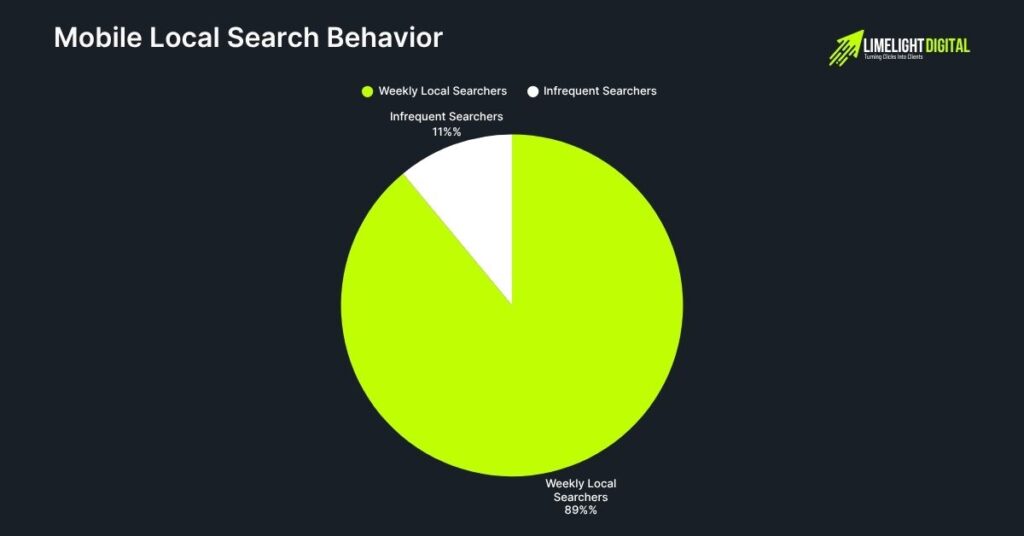
Most mobile users, 89%, conduct local searches weekly, reflecting consistent engagement and strong intent to find nearby products or services.
These searches often lead to direct interaction, as 75% of smartphone users contact businesses immediately after performing a local search.
Source: BrightLocal, Wifitalents, Wiserreview
Online Reviews Impact on Local Search
Online reviews and reputation play a big role in how people choose businesses:
- 83% of consumers read reviews before making a decision, showing that feedback really matters.
- 74% use two or more review platforms, meaning businesses can’t rely on just one site to manage their reputation.
- 31% turn to Instagram for reviews, highlighting how social media is becoming an important place for customers to share and find opinions.
Source: BrightLocal
Local SEO Ranking Factors Statistics
Local SEO ranking factors strongly influence visibility and engagement. Businesses that appear in the Google Local Pack receive around 126% more traffic and calls compared to standard listings.
Studies also show that Local Pack business profiles have a strong backlink presence, averaging 993 backlinks.
Additionally, about 38% of high-ranking Google Business Profiles include the target keyword in their business name, highlighting the importance of relevance in local SEO.
Source: Semrush
Top Local SEO Tools Used by Businesses in the UK
Local SEO tools help businesses improve their online presence and appear in search results when customers are looking nearby.
Here are the SEO top tools used by UK businesses:
1. Google Business Profile
- Primary Local SEO Use Case: Managing local visibility and maintaining a presence on Google Maps.
- Why UK Businesses Use It:
It is the fundamental, free baseline for any UK business. It is almost impossible to show up on Maps or in the “Local 3-Pack” without it. By integrating WhatsApp and using AI-highlighted review topics, it is being utilized more and more for direct consumer interaction in 2026.
Source: Google Business
2. BrightLocal
- Primary Local SEO Use Case: Comprehensive local SEO tracking, automated audits, and citation building.
- Why UK Businesses Use It:
It is a UK-focused platform that knows the local landscape, with its headquarters in Brighton. It is highly appreciated for its “Local Search Grid,” which displays ranks across specific UK postcodes and areas, making it a popular choice among local agencies.
Source: BrightLocal
3. Semrush
- Primary Local SEO Use Case: Local keyword research, competitor analysis, and listing synchronization.
- Why UK Businesses Use It:
UK businesses that already use Semrush for global SEO prefer it for the seamless integration. Its “Listing Management” tool automatically syncs NAP (Name, Address, Phone) data across major UK directories, while its Map Rank Tracker provides pinpoint precision for local SERPs.
Source: Semrush
4. RankTracker
- Primary Local SEO Use Case: High-frequency, hyper-local rank tracking.
- Why UK Businesses Use It:
It excels at granular tracking at the city and postcode level. UK businesses use it to monitor how their rankings fluctuate in specific high-street locations compared to neighboring towns, providing data that general trackers often miss.
Source: Ranktracker
5. Uberall
- Primary Local SEO Use Case: Multi-location listings and reputation management at scale.
- Why UK Businesses Use It:
Ideal for UK agencies or retail chains with hundreds of locations. It uses “Agentic AI” (UB-I) to automatically update opening hours, respond to reviews, and maintain consistency across 150+ directories, ensuring large brands remain visible and accurate across the country.
Source: Uberall
Industry-Specific Local Search Statistics
Industry-specific local searches show clear intent patterns across sectors. Restaurants attract frequent “near me” searches, leading to immediate action.
Retail searches focus on product discovery with location relevance, while healthcare searches reflect appointment intent that often results in calls and consultations.
The table below contains some stats regarding the industry-specific local search:
| Industry | Stat |
|---|---|
| Local “near me” growth | +500% |
| Records mean more visits within 5 min | 72% |
| Inaccurate info deters users | 62% avoid business |
Source: BrightLocal, Search Atlas
Voice Search and Local Discoverability
Voice search is becoming an important way people discover local businesses, especially when they want quick and nearby results.
- 46% of voice search users look for local business information daily, showing frequent local search behavior.
- Approximately 28% of people call a business after performing a voice search, indicating that voice search often leads directly to action.
Source: BrightLocal
Future of Local SEO & AI Trends
Generative AI is now widely used in local SEO. About 88% of local marketers use AI tools for tasks like content, keywords, and optimization. This shows that AI is becoming a normal part of local marketing work.
Many marketers are preparing for the future. Around 59% want to improve their AI skills for SEO, showing that businesses know learning AI is important to stay visible in local search results.
AI tools are also becoming a new place for local searches. 58% of local search results come from ChatGPT, indicating that individuals are beginning to use AI in addition to Google to find local information.
Voice and AI-based searches are growing as well. More users are asking questions using voice and AI tools, especially for local needs. This shows that voice and local AI searches will play a bigger role in how people find nearby businesses.
Source: BrightLocal, Search Engine Land, Ranktracker