SEO drives measurable results, as 68% of online experiences start with search engines, showing organic search is critical for real business ROI.
In this article, we’ll look at SEO analytics, ROI benchmarks, AI-driven search, industry insights, and techniques for increasing traffic, leads, and revenue.
SEO ROI Statistics: Key Insights
- Around 47–54% of website traffic comes from organic search.
- Nearly 70% of clicks are captured by the top three search positions, with #1 alone receiving up to 39.8%.
- Organic search ROI is 2–3× higher than paid campaigns over a year.
- Long-tail keywords account for 70% of organic traffic, indicating an emphasis on intent-driven content.
- SEO ROI grows steadily from 0.8× (6 months) to 5.2× (36 months).
- AI-driven search traffic is growing 12× faster than traditional UK organic search (+0.12% vs. +0.57% YoY).
Organic Search Traffic Statistics That Affect SEO ROI
Let’s look at sections that show how organic search drives traffic, clicks, and real business value.
Traffic & Market Share
- Around 47–54% of website traffic comes from organic search.
- In the UK, Google controls 91.47% of search as of April 2026, and organic search accounts for 50.5% of site traffic. Google’s UK share has been falling by approximately 0.91 percentage points per year since January 2024, after holding steady in the 92-94% band for over a decade.
- UK organic search is expanding slowly at +0.57% YoY, but AI-driven search traffic is growing more quickly at 0.12%, with a 12x YoY growth.
- Globally, Google held a 91.32% share of search engine referrals as of July 2026, according to StatCounter. Bing follows at 4.46%, with Yahoo at 1.24%.
- Google confirmed processing over 5 trillion searches per year, which works out to roughly 13.7 billion searches per day or about 9.5 million every minute.
Click-Through Rates (CTR)
- The top rank in search results attracts 28-39.8% of clicks.
- Positions 2–3 get 15–18%, while positions 4–10 capture only 2–6%.
- This shows that top visibility drives most of the clicks and traffic.
SEO ROI & Impact
- 61% of marketers say organic search drives measurable ROI.
- Organic search ROI is 2–3× higher than paid campaigns over a year.
- 70% of organic traffic comes from long-tail keywords, highlighting the value of targeting intent-rich searches.
- Optimizing for mobile can increase organic traffic by 20-25% on average.
Source: Semrush, Backlinko, SERanking, SEO Works
SEO ROI Compared to Other Marketing Channels
When we look at SEO compared to paid search, email, and paid social, the differences are clear.
SEO usually gives better long-term results, more leads, and higher trust, while paid channels need money to keep working. That’s why many marketers focus on organic search for steady growth.
The table below shows a simple comparison of ROI and performance for different marketing channels:
| Metric | SEO | Paid Search (PPC) | Email Marketing | Paid Social |
|---|---|---|---|---|
| Average ROI Ratio | 22:1 | 2:1 to 4:1 | 36:1 to 42:1 | 2.8:1 |
| Average ROI % | 748% | 155% – 200% | 3,500% – 4,200% | 180% |
| Conversion Rate | 2.4 – 3.0% | 1.5 – 2.0% | 2.8 – 5.3% | 0.7 – 1.2% |
| Close Rate (Leads) | 14.6% | 5 – 7% | N/A | 2 – 3% |
| Traffic Share | 53.3% | 15 – 27% | Owned | 5% (Organic) |
| Trust Factor | 94% | 6% | High | Varies |
| CPC | Decreasing Over Time | $4.22 | Low ($0.03 / msg) | CPA $50+ (Rising) |
Source: HubSpot, Wordstream, FirstPageSage, SeoProfy, SEO Works
SEO ROI by Industry
SEO gives strong, long-term returns across industries, often more than 700%, as organic search brings traffic and leads.
In 2025–2026, the top sectors are Real Estate, Healthcare, Financial Services, and B2B SaaS, usually seeing positive results within a year.
Achieving these results usually requires a baseline SEO investment of $5,000–$10,000 per month.
Strategic SEO ROI Profiles by Industry
SEO doesn’t perform the same way in every industry. Some sectors see returns faster and stronger because their audiences search more often or because trust and expertise are especially important.
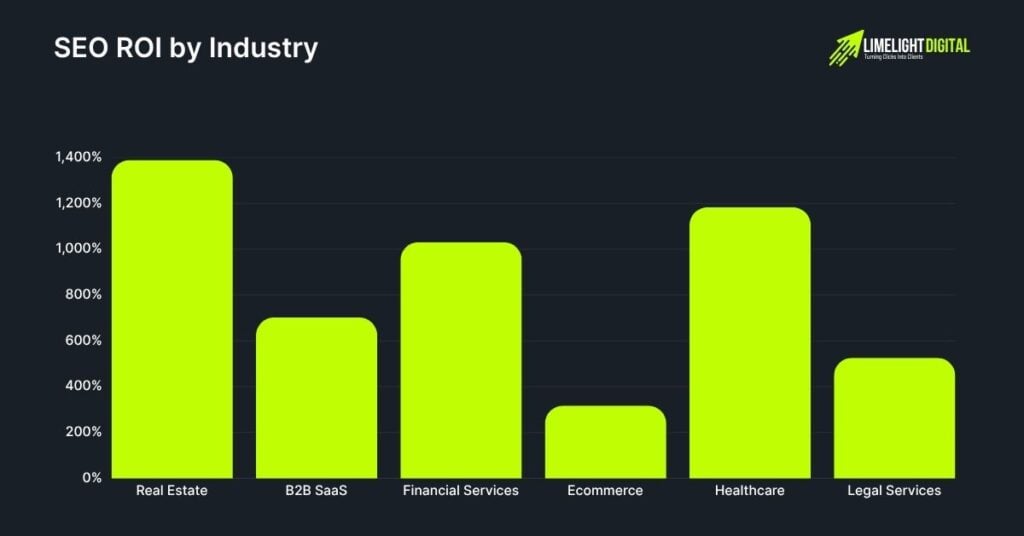
The table below depicts how SEO ROI varies from one industry to another:
| Industry Sector | Average 3-Year ROI | Time to Break-Even | Primary Driver |
|---|---|---|---|
| Real Estate | 1,389% | 8-10 months | Local high-intent queries |
| B2B SaaS | 702% | 7-10 months | Educational |
| Financial Services | 1,031% | 9-12 months | E-E-A-T and regulatory trust |
| Ecommerce | 317% | 9-12 months | Technical Health |
| Healthcare | 1,183% | 9-13 months | Patient Trust |
| Legal Services | 526% | 8-14 months | High value, long-tail niche term |
Source: FirstPageSage, SeoProfy, Reboot, AISEO
ROI Benchmarks For Each Sector
Different industries see different returns from SEO. Some sectors get more traffic, higher conversions, and better visibility in AI search results, which all help grow revenue.
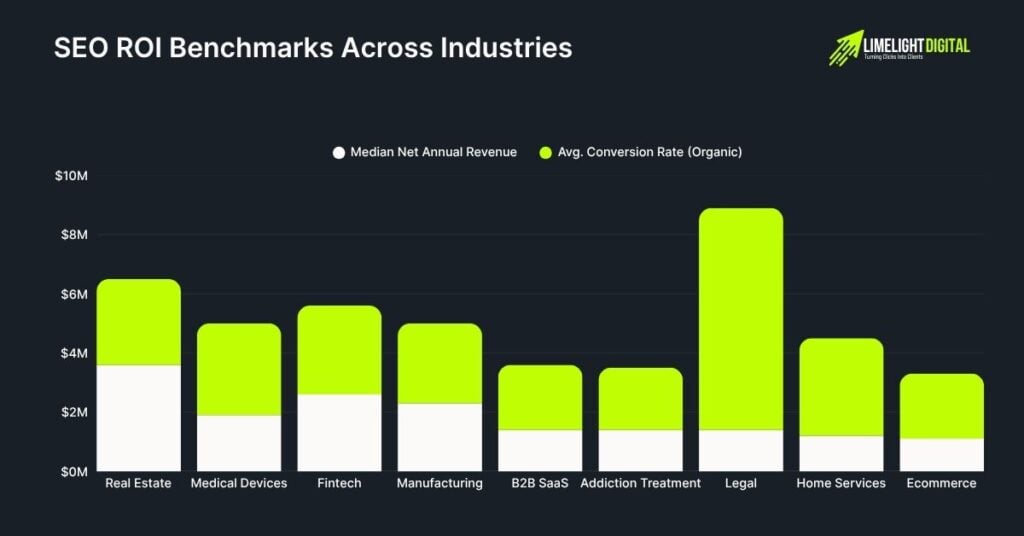
The table below can help teams set goals and compare their performance against similar businesses:
| Industry | ROI Ratio | Median Net Annual Revenue | Avg. Conversion Rate (Organic) | AI Overview Rate |
|---|---|---|---|---|
| Real Estate | 15.1:1 | $3.6M | 2.9% | 13.0% |
| Medical Devices | 12.8:1 | $1.9M | 3.1% | 51.6% |
| Fintech | 11.4:1 | $2.6M | 3.0% | 32.1% |
| Manufacturing | 11.0:1 | $2.3M | 2.7% | 22.0% |
| B2B SaaS | 8.0:1 | $1.4M | 2.2% | 65.9% |
| Addiction Treatment | 8.9:1 | $1.4M | 2.1% | 51.0% |
| Legal | 6.2:1 | $1.4M | 7.5% | 25.0% |
| Home Services | 7.5:1 | $1.2M | 3.3% | 28.7% |
| Ecommerce | 3.6:1 | $1.1M | 2.2% | 25.8% |
Source: FirstPageSage, SeoProfy, Reboot, AISEO
SEO ROI Over Time
SEO doesn’t usually show big returns right away, but its value grows as time goes on. SEO can be a valuable long-term investment due to increased visibility, traffic, and conversions.
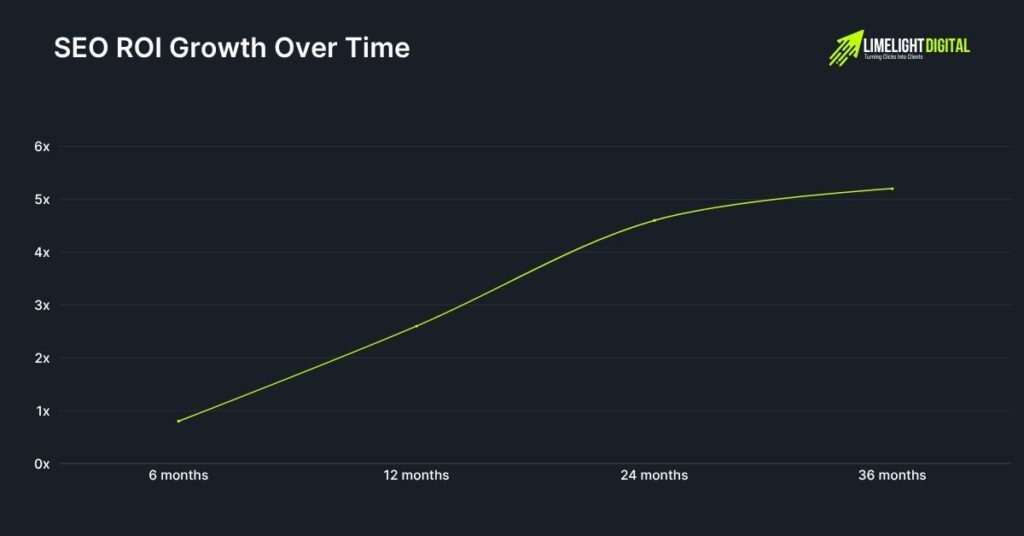
The table below gives a clear picture of it:
| Time Period | SEO Avg. ROI |
|---|---|
| 6 months | 0.8x |
| 12 months | 2.6x |
| 24 months | 4.6x |
| 36 months | 5.2x |
Source: FirstPageSage, AISEO, PurgeDigital
Key SEO Metrics That Drive ROI
Each metric below helps measure how SEO contributes to traffic, leads, and revenue.
Traffic & Engagement Metrics
These show how many people reach your site and how they interact with your content.
- Organic traffic growth: Strong SEO programs often see around 47% year-over-year growth, showing steady top-of-funnel reach.
- Engagement rate (GA4): Healthy engagement is often above 63% for B2B sites and 71% for B2C sites, indicating interesting and relevant content.
Conversion & Attribution Metrics
These connect SEO traffic to real business results.
- Organic visitor-to-lead conversion rate: On average, about 2.4% of organic visitors take a meaningful action.
- First-touch attribution: Organic search accounts for 40-50% of first-touch conversions, demonstrating how SEO frequently starts the client journey.
Keyword & Content Performance Metrics
These measure how well your content matches what people are searching for.
- Keyword ranking growth: Intent-focused content strategies can increase keyword ranking by up to 91% year over year.
- Search intent alignment: Content that matches user intent converts 4.4 times better than content that does not.
AI & Visibility Metrics
These metrics demonstrate how visible your brand is in AI-powered search results.
- AI visibility score: Tools measure brand presence on a 0–100 scale, helping AI startups and agencies track exposure in AI-generated answers.
- AI mentions: Market leaders frequently appear in AI results 10,000 times or more, indicating considerable authority and reach.
- AI Overview prevalence: AI Overviews now appear in a significant share of Google searches. Semrush tracked their prevalence rising to 24.6% in July 2025 before settling at 15.7% by November 2025. Other industry studies estimate the figure has since risen higher in 2026, particularly for informational queries.
Source: Ahrefs, Semrush, Hubspot, SEO Kreativ, FirstPageSage
SEO ROI Myths vs Reality
SEO ROI is often misunderstood, and these common myths hide what the data actually shows about how search really performs. Some of the myths are as follows:
- Myth: SEO is a quick fix.
Reality: SEO takes time to work. Most sites see early ranking changes in 3–6 months, but real business returns usually take 6–12 months or more.
- Myth: AI is killing SEO.
Reality: AI Overviews can lower organic click-through rates significantly. Ahrefs found in their February 2026 update that CTR on position 1 drops by 58% for queries with an AI Overview, up from the 34.5% decline measured in April 2025. Pew Research also found that only 8% of users click on an organic result when an AI Overview is present, compared to 15% without one.
- Myth: Ranking #1 is the only goal.
Reality: Being visible matters more than being perfect. The top three earn over 70% of all clicks, while the top spot receives about 39.8% of all clicks. Strong SEO is about consistent top visibility, not one position.
- Myth: More pages mean better SEO.
Reality: Quality now beats volume. Google’s 2024 updates reward experience, expertise, authority, and trust (E-E-A-T). A few strong, helpful pages often perform better than dozens of weak ones.
- Myth: SEO is a one-time setup.
Reality: SEO is a continuous process. Rankings change as competitors improve and Google updates its system. Continuous updates, testing, and enhancements are required to protect and increase ROI.
- Myth: Local SEO is just about Maps.
Reality: Local SEO drives real buying action. “Near me” searches bring high-intent traffic that often leads to phone calls, store visits, and offline sales. It affects both web results and real-world revenue.
Source: SEO.com, Semrush, Ahrefs
How to Improve SEO ROI: Proven Strategies
Improving SEO ROI means focusing on things that actually make a difference in traffic and conversions.
That includes making pages fast on mobile, earning quality backlinks that send more visitors, and showing up in AI-generated answers where users are more likely to click.
The table below shows benchmarks and targets to follow when improving SEO return on investment:
| Metric | Benchmark |
|---|---|
| CTR for AI-Cited Sources | 1.08% (vs. 0.6% for non-cited) |
| Mobile Page Load Goal (LCP) | < 2.5 Seconds |
| Backlink ROI Factor | 3.8x more traffic |
| Local Conversion Rate | 28% within 24 hours |
| Core Web Vitals / Technical SEO | LCP < 2.5s, INP < 200ms, CLS < 0.1 |
Source: Semrush, Elementor, Backlinko, Safari Digital
SEO ROI Tools & Software
Let us look at the SEO tools and software that help track, measure, and maximize the real business value of your SEO.
1. Semrush
Semrush is ideal when you want one tool for SEO and AI exposure. Its AI Visibility toolkit tracks brand mentions across ChatGPT, Gemini, and Perplexity, helping you see 10K+ AI mentions for market leaders.
It also identifies high-volume AI questions, which can guide content that drives up to 47% YoY organic traffic growth.
Source: Semrush
2. HubSpot
HubSpot shines when you need to link SEO to revenue. Organic search can generate 40–50% of first-touch conversions, linking website traffic to actual deals in your CRM, according to its multi-touch attribution.
Predictive revenue modeling helps prioritize the SEO efforts that generate higher-quality leads.
Source: HubSpot
3. Screaming Frog
Screaming Frog is perfect for pruning low-value content. It uses GA4 and Search Console data to identify underperforming pages that can be removed, merged, or refreshed.
This technique can enhance conversion rates by up to 2.4% merely by focusing on the most important pages.
Source: Screaming Frog
4. Ahrefs
Ahrefs’ Brand Radar monitors citations across 239M+ real user prompts, including unlinked brand mentions on YouTube, Reddit, and AI platforms.
Tracking these mentions helps improve your authority and discover opportunities that can contribute to 91% YoY growth in ranking keywords.
Source: Ahrefs
5. Surfer SEO
Surfer SEO helps your content appear where competitors are already mentioned.
Its AI Tracker identifies “citation gaps,” giving actionable insights to capture more of the ~70% of clicks that go to the top 3 rankings, ensuring your content aligns with high-intent searches.
Source: Surfer SEO
Future SEO ROI Trends & Projections
SEO is rapidly changing, with AI impacting how consumers search and engage online. Traditional search is expected to decline, while AI-powered search expands, opening up new potential for marketers.
Businesses that appear in AI search answers can get more clicks and better leads, making SEO more valuable for revenue in the future.
The table below shows the estimated SEO ROI for 2026 and beyond:
| Metric | 2026 Prediction | 2027 & Beyond Projection |
|---|---|---|
| Traditional Search Volume | ↓ 25% | ↓ 35% |
| Global AI SEO Market Value | $2.43 Billion | $3.1+ Billion |
| Organic CTR (with AI Overview) | 0.61% – 1.08% | < 0.5% (Uncited) |
| Revenue Funneled through AI Search | $550 Billion | $750 Billion (by 2028) |
| Zero-Click Search Rate | 68% | 70% |
| Topical Authority Correlation | 89% | 94% |
| Close Rate for AI-Cited Leads | 23x higher | 30x higher |
Note on Gartner’s prediction: Gartner’s February 2024 prediction that traditional search volume would drop 25% by 2026 has been widely discussed now that the deadline has arrived. While AI chatbots like ChatGPT have grown rapidly (800 million weekly users as of 2026), Google has maintained 91%+ global market share by integrating AI Overviews into its own results. The shift is happening, but as a gradual erosion rather than the sharp decline Gartner projected.
Source: Gartner, Fortune Business Insights, Seer Interactive, McKinsey, SparkToro, Semrush, Soprio.io